If you’ve been waking up exhausted, snoring through the night, or gasping for air without even realizing it, chances are someone in your life has already suggested you get tested for sleep apnea. But traditional sleep studies are expensive, inconvenient, and let’s be honest, nobody wants to spend a night in a lab wired up to a dozen sensors. That’s exactly why sleep apnea ring monitors have exploded in popularity. They’re small, wearable, and promise to track your oxygen levels and breathing patterns while you sleep, all from your finger. But do they actually work? Let’s break it all down.
What Is a Sleep Apnea Ring Monitor?
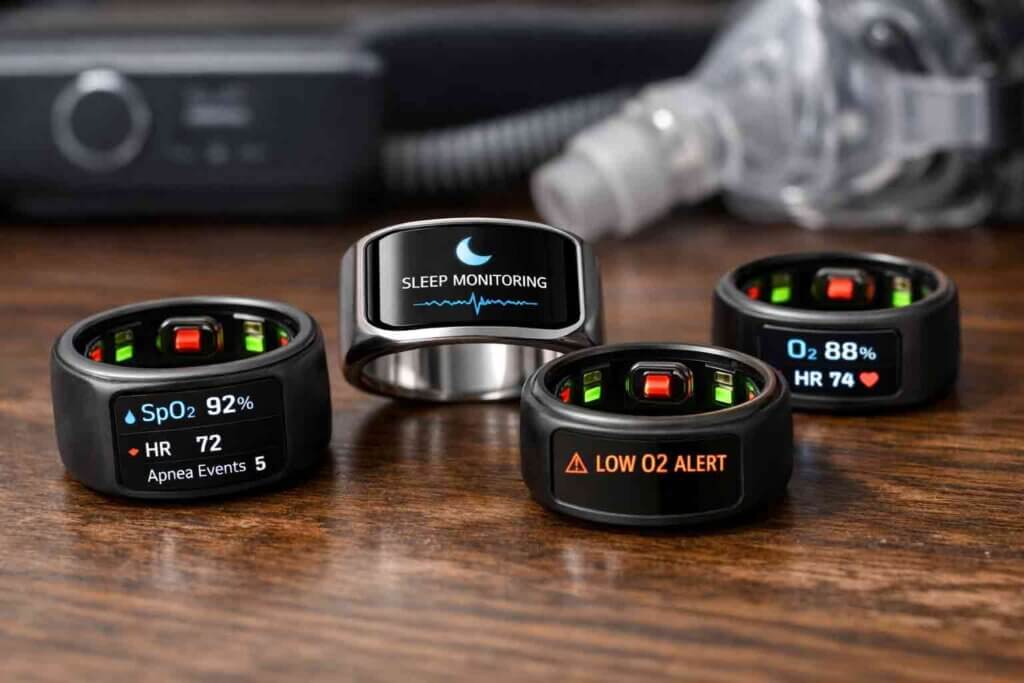
A sleep apnea ring monitor is a small wearable device worn on your finger during sleep. It uses pulse oximetry technology to measure your blood oxygen saturation (SpO2) and heart rate continuously throughout the night. When oxygen levels drop repeatedly, it can indicate apnea events, moments where your breathing stops or becomes severely restricted.
These rings are not clinical diagnostic tools in the traditional sense, but they serve as a powerful screening and monitoring solution. Products like the blēo Ring, Evie Ring, and Oura Ring have brought this technology into mainstream consumer health tracking.
How Do Sleep Apnea Rings Work?
The core technology inside a sleep apnea ring is a photoplethysmography (PPG) sensor. This sensor emits light into your skin and measures how much is absorbed by your blood. Oxygenated blood absorbs light differently than deoxygenated blood, which is how the device calculates your SpO2 percentage in real time.
Throughout the night, the ring logs your oxygen levels, detects drops (called oxygen desaturation events), and tracks your heart rate variability. Most rings pair with a smartphone app that generates a morning report showing your average SpO2, the number of desaturation events, how low your oxygen dropped, and how long each event lasted.
Some advanced models also track movement and sleep position, giving you a more complete picture of what’s happening while you sleep.
Do Sleep Apnea Ring Monitors Actually Work?
The Short Answer
Yes, sleep apnea ring monitors work as screening tools, but they are not a replacement for a formal polysomnography (PSG) or home sleep apnea test (HSAT) prescribed by a doctor.
The Longer Answer
Multiple studies have examined the accuracy of consumer pulse oximetry rings in detecting sleep-disordered breathing. Research consistently shows that continuous overnight pulse oximetry has a reasonable sensitivity for identifying moderate to severe obstructive sleep apnea. The more frequently your oxygen drops below 90% during the night, the higher the likelihood that something serious is going on.
The key metric sleep apnea rings track is the Oxygen Desaturation Index (ODI), which counts how many times per hour your SpO2 drops by 3 or 4 percent or more. An ODI above 5 per hour is generally considered abnormal. An ODI above 15 or 30 suggests moderate or severe sleep apnea respectively. When ring data correlates with these thresholds, it lines up reasonably well with clinical findings.
That said, pulse oximetry alone does not measure airflow, respiratory effort, or brain activity, which are all components of a full sleep study. A ring cannot tell you whether you have central sleep apnea versus obstructive sleep apnea, for instance. And for mild cases, the accuracy is lower.
Who Should Consider Using a Sleep Apnea Ring?
Sleep apnea ring monitors are best suited for:
People who snore loudly and want to get a clearer picture before committing to a full sleep study. Individuals who have already been diagnosed with sleep apnea and are using a CPAP machine, but want to track how well their therapy is working night to night. Anyone who travels frequently and wants a compact, portable way to keep tabs on their overnight oxygen. People who have risk factors for sleep apnea such as obesity, hypertension, or a large neck circumference but haven’t been formally evaluated yet.
They are not intended for children, and they should not be used as a diagnostic device without follow-up from a healthcare provider.
Best Sleep Apnea Ring Monitors on the Market
blēo Ring
The blēo Ring is widely regarded as one of the most accurate consumer-grade sleep apnea rings available. It provides continuous SpO2 and heart rate monitoring, vibrates gently when your oxygen drops below a threshold you set, and generates detailed PDF reports you can share with your doctor. It has a battery life of up to 16 hours, making it comfortable for a full night’s sleep.
Evie Ring
The Evie Ring was designed with women’s health in mind but offers robust overnight SpO2 tracking that applies to anyone concerned about sleep apnea. Its comfortable open-band design and real-time app sync make it a practical daily-wear option.
Oura Ring Gen 3
The Oura Ring Gen 3 is one of the most popular smart rings in the world. While it’s primarily known as a wellness tracker, it includes overnight SpO2 monitoring and sleep stage analysis. It doesn’t provide a dedicated ODI score the way the Wellue does, so it’s more of a general health monitor than a targeted apnea screening tool.
SleepU Wrist Worn Oximeter
While not technically a ring, the SleepU deserves mention because it wraps around the wrist with a finger probe and delivers clinical-grade continuous oxygen monitoring with detailed reporting. It’s one of the most physician-recommended home options.
How Accurate Are Sleep Apnea Rings Compared to a Sleep Study?
This is the big question everyone wants answered. The honest answer is that sleep apnea rings are accurate enough to flag a problem but not precise enough to diagnose one on their own.
A formal polysomnography measures over a dozen variables simultaneously, including brain waves, eye movement, muscle activity, airflow, respiratory effort, chest movement, and blood oxygen. A ring measures one, maybe two of those variables.
Studies comparing pulse oximetry-based ODI scores to AHI (Apnea-Hypopnea Index) scores from full sleep studies show a moderate to strong correlation in patients with moderate to severe sleep apnea. However, in people with mild sleep apnea or with central sleep apnea, the ring often underestimates the severity of the condition.
The takeaway is this: if your ring shows repeated overnight oxygen dips, take that seriously and see a doctor. If your ring shows clean data but you still feel exhausted, that also doesn’t rule out a sleep disorder, and a clinical evaluation is still warranted.
Can a Ring Monitor Replace a Sleep Study?
No, But It Can Accelerate the Process
A sleep apnea ring cannot replace a polysomnography or even a Level 3 home sleep apnea test. However, it can serve as a powerful first step that helps you and your doctor make a faster, more informed decision about whether to move forward with formal testing.
Many people go years without getting evaluated for sleep apnea because the barrier to entry feels high. A ring monitor reduces that barrier significantly. You wear it to bed, wake up with data, and if the data looks concerning, you have something tangible to bring to your physician.
In that sense, sleep apnea rings don’t replace the system. They improve access to it.
What the Data From a Sleep Apnea Ring Tells You
Most sleep apnea ring apps report the following metrics each morning:
Average SpO2 is your mean blood oxygen level throughout the night. A healthy average is typically 95% or above. Minimum SpO2 shows the lowest point your oxygen reached during the night. Drops below 90% are clinically significant. ODI (Oxygen Desaturation Index) counts how many times per hour your oxygen dropped by 3 or 4 percent. Heart rate trends show fluctuations that may correspond with breathing disruptions. Time below threshold tells you what percentage of the night your SpO2 spent below a set level, often 90%.
When these numbers are consistently abnormal over several nights, it’s a strong signal that something is wrong and worth investigating further.
Limitations of Sleep Apnea Ring Monitors
Being informed about what a ring monitor cannot do is just as important as understanding what it can do.
Movement artifacts can cause false readings, particularly if you’re a restless sleeper. Some rings are more prone to this than others. Skin tone and circulation can affect pulse oximetry accuracy. Research has raised questions about whether pulse oximetry devices are less accurate in people with darker skin tones, which is an important consideration. Ring fit matters more than people realize. A loose or poorly fitted ring will produce inconsistent data. No EEG or airflow data means the ring cannot classify the type of apnea or detect hypopneas that don’t cause oxygen drops. Cold hands or poor peripheral circulation can reduce sensor accuracy significantly.
Should You Talk to a Doctor Before Using One?
You don’t need a prescription to buy a sleep apnea ring monitor. But if you suspect you have sleep apnea, speaking with a doctor should always be part of the process. A ring monitor can give you information, but a doctor can give you a diagnosis, a treatment plan, and, most importantly, peace of mind backed by clinical evidence.
If you bring ring data showing repeated oxygen desaturations to your physician, most will take it seriously and use it to guide their recommendations, whether that’s a formal home sleep test, a referral to a sleep specialist, or other steps.
Are Sleep Apnea Rings Worth Buying?
For the price, typically between $50 and $400 depending on the device, sleep apnea rings offer excellent value as a screening and monitoring tool. They are non-invasive, comfortable, and capable of generating useful data that goes beyond what a basic fitness tracker provides.
If you’re in the “I think something might be wrong but I haven’t done anything about it yet” camp, a sleep apnea ring is a low-commitment way to get objective data. If you’re already on CPAP therapy, using a ring to track your overnight SpO2 is a smart and affordable way to verify your therapy is working as intended.
They are not a substitute for medical care, but in a world where healthcare access is often slow and expensive, they are a genuinely useful bridge.
Conclusion
Sleep apnea ring monitors do work, within a clearly defined scope. They are effective at continuously tracking blood oxygen levels overnight, flagging desaturation events, and giving you a baseline understanding of your breathing health while you sleep. They’re not diagnostic devices, and they can’t replace a proper sleep study, but they are far more useful than doing nothing. If you’re waking up tired, snoring loudly, or have reason to believe your sleep quality is poor, a sleep apnea ring is a smart, accessible first step. Use it as a conversation starter with your doctor, not a conclusion on its own, and you’ll get the most value out of what the technology genuinely has to offer.
Frequently Asked Questions
1. Can a sleep apnea ring diagnose sleep apnea?
No. A sleep apnea ring cannot diagnose sleep apnea. It tracks blood oxygen levels and flags potential issues, but a formal diagnosis requires a clinical sleep study conducted or reviewed by a licensed physician.
2. How accurate are sleep apnea rings?
They are reasonably accurate at detecting moderate to severe sleep apnea through oxygen desaturation tracking. Accuracy decreases for mild cases. They should be treated as a screening tool, not a medical-grade diagnostic device.
3. Which finger should I wear a sleep apnea ring on?
Most manufacturers recommend the index or middle finger on either hand. The fit should be snug but comfortable. A loose ring produces unreliable readings.
4. Can I use a sleep apnea ring if I already use a CPAP machine?
Yes, and it’s actually one of the best use cases. Wearing a ring while on CPAP therapy helps you verify that your oxygen levels are staying stable throughout the night and that your therapy is working effectively.
5. Do sleep apnea rings work for everyone?
Not equally. Accuracy can be affected by skin tone, poor circulation, cold hands, and restless sleeping. People with darker skin tones may experience reduced oximetry accuracy, a limitation that applies to pulse oximetry devices broadly.