Anyone who has tried to log a meal manually knows the friction: searching a database for “grilled chicken breast, no skin, 6 oz,” guessing at portion sizes, and giving up after three days. Photo-based meal tracking removes most of that friction by letting a camera and an AI model do the identification and estimation work. But how accurate is it really, and what’s actually happening between the moment you snap a photo and the moment a calorie count appears on your screen?
This article breaks down the technology behind AI nutrition coaches that use photo recognition, what the research says about their accuracy, and how to get the most reliable results from them.
What Happens When You Photograph a Meal
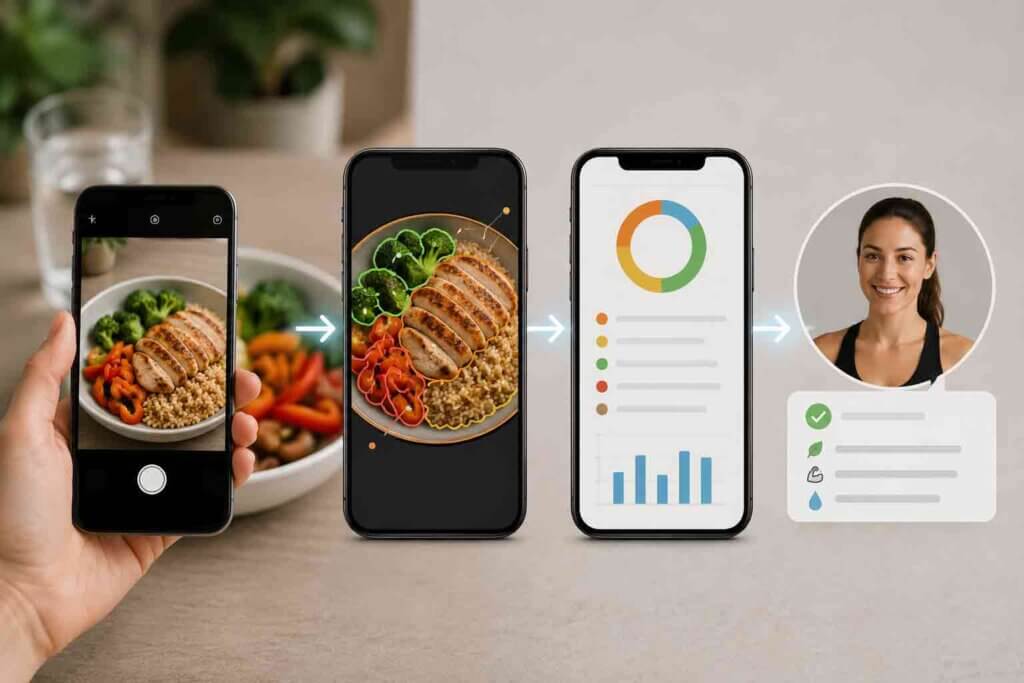
A photo-based meal tracker runs through four distinct steps every time you snap a picture of food.
First, the app identifies the food items in the image using object detection, a computer vision technique trained to recognize shapes, colors, and textures associated with specific dishes. Second, it estimates portion size based on visual cues, such as plate diameter, food height, and reference objects in frame. Third, it retrieves nutritional values from a food database, matching the identified item to a stored calorie and macronutrient profile. Fourth, it combines recognition and portion data to calculate a total estimate for calories, protein, carbohydrates, and fat.
Modern systems typically rely on convolutional neural networks or transformer-based architectures for the recognition step, the same family of models used in broader image classification tasks. The portion estimation step is the more difficult engineering problem, since a 2D photo inherently lacks depth information, and the app has to infer volume from a flat image.
How Accurate Is AI Food Recognition, Really
The honeymoon numbers from lab benchmarks look impressive. Research has reported AI models reaching well above 95% recognition accuracy on curated food image datasets under controlled conditions. Those numbers reflect performance on clean, well-lit, single-item photos in a research environment, not a phone photo of a half-eaten dinner under restaurant lighting.
Real-world performance tells a more useful story. A 2025 randomized controlled trial of an AI image-recognition meal-reporting app, tested with young adults eating in realistic restaurant-style conditions, found that the AI correctly identified 86% of dishes, but only 68% of meals were accurately reported end-to-end once portion-size entry was factored in. That gap between item recognition and full nutritional accuracy is the most important distinction to understand about these tools: identifying what you ate is a largely solved problem; estimating how much of it you ate is still the weak link.
A 2025 scoping review in Frontiers in Nutrition examined AI-based dietary assessment tools and found that real-world performance varies widely depending on dataset diversity, food complexity, lighting conditions, and whether the app lets users manually correct an estimate. Single, simple foods like an apple or a slice of bread are recognized with high reliability, often in the 85–95% range. Complex, mixed dishes such as casseroles, stir-fries, or layered salads remain the hardest category for any current system, since ingredients are visually blended and harder to separate.
On the calorie-accuracy side specifically, most consumer AI food trackers land somewhere in a 10–20% error range for typical meals, with portion estimation responsible for the bulk of that error, often ±15–30% on its own. For context, a 2024 meta-analysis published in connection with JMIR mHealth and uHealth research found that even high-quality image-based dietary assessment methods underreport energy intake by roughly 20% compared to doubly labeled water, the clinical gold standard for measuring true energy expenditure. That sounds discouraging until you compare it to the alternative: traditional text-based food diaries underreport intake by 11% to 41%, meaning photo-based methods are a meaningful improvement over manual logging, even if they are not a substitute for a kitchen scale in clinical settings.
Why Photos Beat Manual Logging Anyway
Accuracy in isolation is not the whole picture. A 2025 randomized controlled trial comparing an AI image-recognition app against a voice-only meal-reporting app found that the image-based method significantly outperformed voice logging on both identification accuracy and time efficiency. Speed matters more than people expect, because the biggest predictor of whether someone keeps a food log isn’t precision, it’s whether they keep doing it at all.
This is the core trade-off behind AI nutrition coaching: a method that’s 80% accurate and takes five seconds will produce far more useful long-term data than a method that’s 95% accurate and takes five minutes, because most people abandon the slower method within a week. Research on dietary tracking adherence consistently shows that friction, not accuracy, is the primary driver of dropout. Photo-based logging directly targets that friction point.
What Actually Affects Accuracy in Practice
Several variables determine how well an AI nutrition coach performs on any given photo.
Lighting has an outsized effect. Good natural light dramatically improves recognition, while dim restaurant lighting or harsh shadows can cause the model to misjudge what’s on the plate. Framing and angle matter too: a centered, top-down or 45-degree shot that captures the entire plate gives the algorithm more reliable depth and scale cues than a cropped or angled photo. Food complexity is a major factor, since mixed dishes with sauces, layered ingredients, or hidden components (a casserole, a loaded burrito) are inherently harder to decompose than a plate with clearly separated items. Reference objects in frame, like a standard-sized fork or plate, help portion-estimation algorithms calibrate scale. Database coverage also matters; most recognition systems perform best on widely studied, common foods and struggle more with regional or traditional dishes that are underrepresented in training data.
The presence of a correction feature is one of the most consistent predictors of real-world accuracy across the research. Apps that let users tap to adjust a misidentified food or fine-tune a portion size after the AI’s initial guess consistently produce better logged data than apps that treat the AI output as final.
Best Practices for Better Photo-Based Tracking
To get the most reliable estimates from an AI nutrition coach:
- Shoot in natural or bright, even light whenever possible, and avoid backlighting or strong shadows across the plate.
- Capture the entire meal in frame, including sauces, sides, and beverages, rather than cropping to the main item.
- Include a familiar reference object (a standard fork, a known plate size) to help with portion calibration.
- Take the photo before eating begins, since partially eaten meals are harder for the model to interpret accurately.
- Use the correction or adjustment feature when you know specifics, such as an exact weighed portion or a different cooking method (fried versus grilled), since these details change the nutritional profile substantially.
- Treat the output as a strong estimate for trend-tracking, not a clinical-grade measurement, unless you’re working with a healthcare provider who has validated the specific tool for that purpose.
The Realistic Way to Think About AI Nutrition Coaching
Photo-based meal tracking isn’t trying to replace a metabolic ward or a dietitian with a food scale. It’s solving a different, more practical problem: making consistent dietary tracking achievable for people who would otherwise quit a food diary within days. The research is consistent on this point. Identification accuracy is genuinely strong for common, single-component foods. Portion estimation remains the harder problem and the main source of error. And even with that error margin, photo-based methods outperform both manual food diaries and voice-only logging on the metric that predicts results over time: whether people actually keep using them.
For most users, the practical takeaway is straightforward: AI food recognition gives you a fast, “good enough” starting point. Consistency in logging, paired with occasional manual corrections for foods you know precisely, will get you closer to an accurate long-term picture of your eating patterns than chasing perfect single-meal accuracy ever will.
A Brief Look at the Technology Stack
Understanding why photo-based tracking works the way it does requires a quick look under the hood, because the limitations aren’t arbitrary, they’re a direct consequence of how the underlying models are built.
Food recognition models are trained on large labeled datasets of food photographs, where each image has been manually tagged with the dish it represents. The model learns to associate visual patterns, edges, color gradients, textures, shapes, with specific food categories. This is the same general approach used in other image classification tasks, from medical imaging to autonomous vehicle perception, just narrowed to a food-specific vocabulary.
The quality of that training data sets a ceiling on real-world performance. A model trained primarily on North American and Western European dishes will recognize a hamburger or a Caesar salad far more reliably than it recognizes a regional dish that’s underrepresented in its training set. This is why research consistently flags database coverage as one of the leading sources of error for users eating cuisines outside the most commonly photographed categories.
Portion estimation works differently and is, by most accounts, the harder of the two problems. Because a standard phone photo is a 2D projection of a 3D plate, the model has no direct measurement of volume or depth. Instead, it relies on proxy signals: the apparent size of the food relative to the plate, the plate’s estimated diameter based on typical tableware sizes, shadow patterns that hint at height, and sometimes a reference object placed deliberately in frame. Some more advanced systems use depth-sensing cameras or stereo imaging to capture actual depth data, which is part of why the fixed meal-tray photography devices used in some hospital settings report different usability and accuracy profiles than handheld phone photos taken by users in the wild.
Once a food item is identified and a portion size is estimated, the final step is a database lookup. The app matches the recognized food to a stored nutritional profile, drawn from standardized food composition databases, branded product databases, or restaurant menu data where available, and multiplies by the estimated portion to generate a calorie and macronutrient total. Errors can compound at every stage: a misidentified food pulls the wrong nutritional profile entirely, while a correctly identified food with a misjudged portion produces a proportional error in the final number.
Comparing Tracking Methods Side by Side
It helps to see how photo-based tracking stacks up against the alternatives people have relied on for decades.
| Method | Typical Accuracy Range | Time Per Entry | Primary Failure Mode |
|---|---|---|---|
| Kitchen scale + manual database lookup | Highest, near clinical-grade when used consistently | 2–5 minutes | Abandonment due to effort |
| Text-based food diary | Underreports by 11–41% | 1–3 minutes | Recall bias, portion guessing |
| Voice-only logging | Lower accuracy and slower than image methods in head-to-head testing | 30–60 seconds | Vague descriptions, no visual reference |
| Photo-based AI tracking | Roughly 10–20% error on typical meals; ±15–30% on portion size specifically | 5–15 seconds | Portion estimation, complex/mixed dishes |
| 24-hour dietary recall (clinical) | Variable, dependent on interviewer skill | 15–30 minutes | Memory decay, social desirability bias |
The pattern that emerges from this comparison is consistent with what the underlying research shows: no consumer-friendly method matches the accuracy of a kitchen scale, but photo-based tracking offers the best balance of speed and accuracy among methods people will actually sustain over weeks or months. That sustainability factor is what ultimately determines whether a tracking method produces useful data at all, since a perfectly accurate method that gets abandoned after four days produces no usable trend data, while an imperfect method used consistently for three months produces a meaningful picture of eating patterns.
Where Photo-Based Tracking Is Being Used Beyond Personal Weight Management
While most consumers encounter AI nutrition coaching through weight-loss or fitness apps, the same underlying technology has found traction in clinical and institutional settings, where the accuracy and usability trade-offs look somewhat different.
In hospital settings, automatic meal-tray photography devices have been developed to estimate food and liquid intake for patients, particularly those at risk of malnutrition or those whose intake needs to be monitored closely without burdening nursing staff with manual logging. One evaluation of such a device found that an automated camera system, mounted to photograph meal trays without requiring a staff member to manually take the picture, scored significantly higher on system usability scale (SUS) ratings than a comparable tablet-based manual photography process, 63.2 versus 56.0 out of 100. That gap illustrates the same friction-reduction principle seen in consumer apps: removing a manual step, even a small one like picking up a tablet and aiming it, measurably improves whether the tool gets used consistently in practice.
Diabetes management is another area where photo-based estimation is being explored, since carbohydrate counting accuracy directly affects insulin dosing decisions. Researchers and engineering teams, including work originating from groups like NYU Tandon School of Engineering, have built AI systems specifically aimed at giving people with diabetes or weight-related health conditions a faster way to estimate the nutritional content of a meal from a single photo, reducing the friction associated with carb counting at every meal.
These institutional applications matter for a broader reason: they reveal that the core challenge isn’t unique to any one app or company. Whether the use case is a consumer trying to lose ten pounds or a hospital trying to track a patient’s caloric intake, the same two bottlenecks show up again and again, portion estimation accuracy and user adherence, and the same general solution, reducing friction at the moment of data capture, tends to move the needle on both.
Common Misconceptions About AI Food Recognition
A few misunderstandings come up repeatedly when people evaluate whether to trust a photo-based tracker, and they’re worth addressing directly.
“The AI weighs my food.” It doesn’t, and it can’t from a single 2D photo. Every photo-based system is estimating volume and mass from visual cues, not measuring it. This is the single most important thing to understand about the technology, because it explains almost every accuracy limitation discussed above.
“High lab accuracy numbers mean the app will be that accurate for me.” Benchmark accuracy figures, the 95%+ recognition rates reported on curated datasets, reflect performance under ideal conditions: clean backgrounds, single items, controlled lighting. Real-world accuracy, measured in randomized controlled trials with people eating in actual restaurants and kitchens, is consistently and substantially lower. Anyone evaluating a tool should look for real-world validation data, not just lab benchmark claims.
“If the app gets it wrong once, it’s not useful.” Single-meal accuracy isn’t really the right metric. Because tracking errors don’t all point in the same direction, some overestimate, some underestimate, the value of the method comes from trends across days and weeks, not the precision of any single logged meal. A tool that’s directionally correct and used daily will tell you more about your eating patterns than a tool that’s occasionally precise and used twice a month.
“AI tracking is only useful for weight loss.” As the clinical and hospital examples above show, the same technology is being applied to malnutrition monitoring, diabetes management, and institutional dietary tracking, contexts where the goal isn’t aesthetic weight change but health monitoring and risk reduction.
Frequently Asked Questions
Is photo-based calorie tracking accurate enough to trust for weight loss?
For most people pursuing general weight management, yes, with the understanding that estimates carry a meaningful margin of error, typically in the 10–20% range for calories on a given meal. Used consistently over weeks, the trend data is generally reliable enough to guide decisions, even though any single logged meal may be off by a noticeable margin.
Why does the AI sometimes misidentify simple foods?
Lighting, camera angle, and how the food is plated all affect recognition. A food photographed in dim light, partially obscured by other items, or photographed at an unusual angle is harder for the model to classify correctly than the same food shot in good light from a standard angle.
Do these apps get more accurate over time?
Many do, in two ways. First, the underlying AI models are periodically retrained on larger and more diverse datasets, which improves baseline recognition across the board. Second, on an individual level, apps that learn from a user’s manual corrections, you tend to eat the same handful of meals repeatedly, can improve personalized accuracy for that specific user’s common foods.
Should I still use a food scale?
If precision matters for a specific medical reason, such as carbohydrate counting for insulin dosing or participation in a clinical nutrition study, a food scale paired with verified nutritional data remains the more accurate option. For general dietary awareness and weight management, the speed and consistency benefits of photo-based tracking generally outweigh the accuracy gap for most users.
What’s the single biggest factor in getting an accurate estimate?
Good lighting combined with a complete, unobstructed view of the plate. Both are free, require no extra steps beyond aiming the camera properly, and address the two most commonly cited sources of recognition error in the research.
Sources
- Sahoo, A. et al. (2025). Randomized controlled trial of AI image-recognition meal-reporting app vs. voice-only logging in real-world dining conditions. As cited in: “Apps That Calculate Calories From Photos: Are They Accurate?” — fitia.app, 2026. https://fitia.app/learn/article/ai-calorie-photo-apps-accuracy-2026/
- Phalle, S. & Gokhale, P. (2025). Scoping review of AI-based dietary assessment tools. Frontiers in Nutrition. As cited in: “Apps That Calculate Calories From Photos: Are They Accurate?” — fitia.app, 2026. https://fitia.app/learn/article/ai-calorie-photo-apps-accuracy-2026/
- Lee, J. et al. (2024). Meta-analysis comparing image-based dietary assessment to doubly labeled water. JMIR mHealth and uHealth. As cited in: “Apps That Calculate Calories From Photos: Are They Accurate?” — fitia.app, 2026. https://fitia.app/learn/article/ai-calorie-photo-apps-accuracy-2026/
- “How Accurate is AI Food Recognition? The Science Behind Photo-Based Calorie Counting” — KCALM, 2026. https://www.kcalm.app/blog/ai-food-recognition-accuracy/
- “Smart AI Food Tracker: Track Meals with Photos & Voice” — Welling, 2026, citing image-based food recognition systems research (ScienceDirect). https://www.welling.ai/articles/ai-food-tracker
Note: Figures above are drawn from secondary reporting on the cited primary studies. Readers building clinical or research applications should verify findings directly against the original peer-reviewed sources before citing them further.