Key Takeaways
- Watch faces are the single highest-impact personalization option — choose hybrid analog-digital styles for the best of both worlds.
- Interchangeable bands (silicone, leather, metal, woven) let you adapt your smartwatch to any occasion without buying a new device.
- Nearly 50% of consumers globally prefer customizable straps and watch faces, making personalization the market’s primary growth driver (Market.us, 2026).
- 68% of smartwatch owners purchase at least one additional band after buying their device (Business Research Insights, 2026).
- Match your customization strategy to your primary use case: health tracking, professional style, or fitness performance.
- Avoid bespoke finishes that sacrifice durability; consider resale value before committing to permanent modifications like engraving.
Smartwatch personalization blends seamlessly with continuous health data around the wearer — and in 2026, it has become a decisive purchase factor. With 562.86 million smartwatch users worldwide, a 23.7% increase from 2024 (DemandSage, 2026), and over 92% relying on their devices for health and fitness tracking, the best personalization options are those that balance self-expression with practical function. The global smartwatch market is expected to reach nearly $49 billion in 2026, up from $39 billion in 2025 (Accio, 2026) — driven significantly by demand for deeper personalization. Watch faces represent perhaps the most visible and impactful personalization option available on modern smartwatches — but bands, bezels, complications, and app layouts matter just as much.
Understanding which personalization elements will truly benefit your daily routine requires careful consideration of your priorities, whether they lean toward professional functionality, fitness tracking, or simply making a fashion statement.
Watch Faces: The Foundation of Smartwatch Personalization
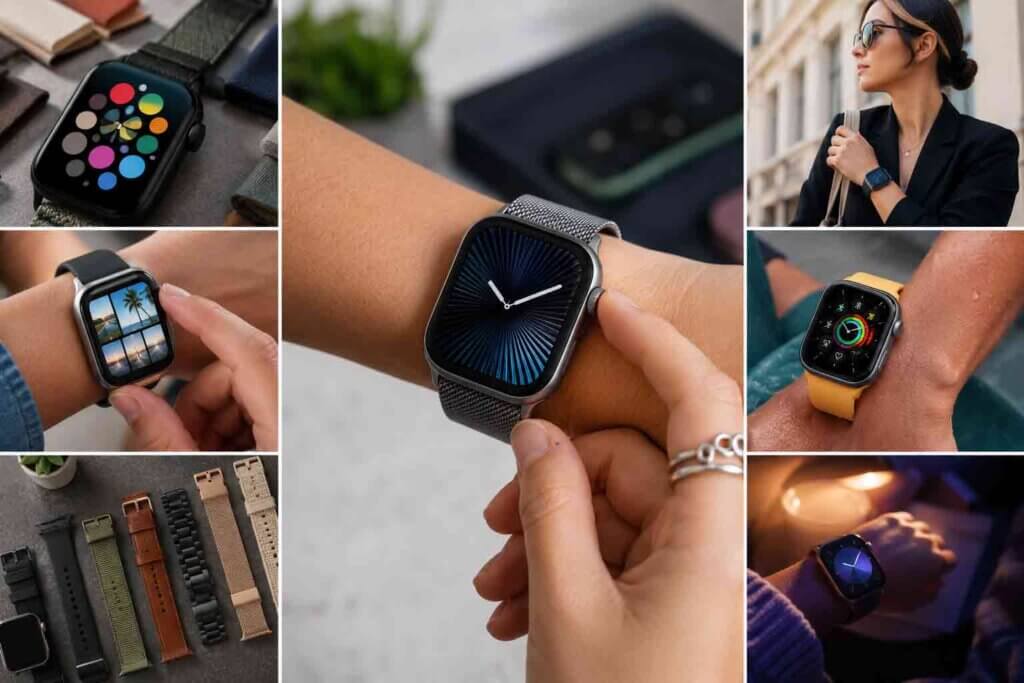
Watch faces are the first — and most frequently changed — personalization layer on any smartwatch. The variety spans from classic analog designs that mimic traditional timepieces to cutting-edge digital displays that showcase real-time health metrics, weather updates, and calendar notifications.
Analog watch faces consistently hold the highest consumer search volume, peaking in December and August, according to market analysis by Accio. This signals sustained, recurring demand tied to gifting seasons and summer fashion cycles.
Hybrid faces — combining analog aesthetics with digital health complications — offer the strongest balance of style and function. Many users find that a hybrid face showing steps, heart rate, and a classic hour hand eliminates the need to choose between fashion and data.
Digital health dashboards are preferred by users focused primarily on performance metrics: VO₂ max, heart rate variability (HRV), sleep scores, or real-time workout data. Most major smartwatch platforms allow users to customize complication layouts, widget placement, and color schemes so the display matches their wardrobe or activity type.
Bands and Straps: The Most Versatile Personalization Tool
Interchangeable bands are the easiest, most reversible way to transform both the look and feel of a smartwatch. Common materials include:
- Silicone — durable, sweat-resistant, ideal for workouts and casual wear; accounts for approximately 46% of global band demand (Business Research Insights, 2026)
- Leather — professional aesthetic, best for office or formal settings; popular among premium smartwatch users
- Metal (stainless steel, titanium) — premium look, heavier, suited to dress occasions; represents nearly 24% of band sales
- Woven/nylon — lightweight, breathable, versatile across fitness and casual use; approximately 30% of combined nylon and leather demand
According to Business Research Insights (2026), 68% of smartwatch owners purchase at least one additional band after acquiring their device, and nearly 41% replace their band within the first 12 months of ownership. Third-party band ecosystems have expanded dramatically, giving users hundreds of options at various price points without affecting core health sensor functionality.
Bezels, Cases, and Protective Accessories
Some smartwatch lines offer interchangeable bezels that physically alter the case shape and aesthetic without requiring a new device. This option appeals to users who want to shift between a sporty look for weekends and a cleaner profile for work.
Protective covers and cases add another layer of personalization. Clear, color-tinted, or matte-finish cases can subtly shift the device’s appearance while shielding it from scratches. However, covers that encroach on sensor areas (especially optical heart-rate sensors on the underside of the case) can reduce health-tracking accuracy — a trade-off worth evaluating before purchase.
Complications, Widgets, and App Layouts
Beyond visual aesthetics, smartwatch personalization extends into how information is organized and surfaced:
- Complications are small data windows embedded directly in the watch face. Users focused on longevity tracking benefit most from HRV, SpO₂ (blood oxygen), sleep score, and recovery readiness complications.
- Widget stacks allow swipe-accessible panels for weather, calendar, or workout summaries — reducing reliance on the phone.
- App arrangement on the watch grid affects how quickly users can access key tools like GPS workouts, meditation timers, or ECG readings.
Those primarily interested in health tracking benefit most from customizable health dashboards and fitness-focused complications. Users who value style and versatility find greater satisfaction in interchangeable bands and elegant watch faces that complement various outfits and occasions.
Limited Editions, Engravings, and Bespoke Options
Limited edition smartwatch models provide exclusive aesthetic options for users seeking something distinctive, often including unique band materials, special watch face libraries, and co-branded packaging. High-end collaborations between watchmakers and fashion houses have become a growing segment, blending traditional craftsmanship with modern health-tracking features.
Professional engraving services can add personal meaning to a device — but come with important caveats:
- Permanent modifications typically affect resale value
- Engraved devices are not easily returned or exchanged
- Some finishes (titanium or ceramic) are more engraving-friendly than aluminum or glass
Unique specialty finishes — while visually striking — may be more susceptible to visible wear or micro-scratching than standard anodized aluminum. The balance between bespoke design and practical longevity requires honest assessment of how intensively you use the device day-to-day.
Personalized Health & Fitness Customization
Modern smartwatches excel at providing personalized health and fitness guidance that adapts to your unique physiological profile and goals. This is arguably the most underutilized dimension of smartwatch personalization.
Key health personalization features include:
- Custom activity goals — daily step targets, calorie burns, stand reminders calibrated to your baseline
- Personalized coaching — AI-driven recommendations for workout intensity, sleep schedules, and recovery windows
- Adaptive watch faces — some platforms automatically switch to a workout-optimized face when a session begins
- Health notification thresholds — users can set personal upper and lower bounds for heart rate alerts, ECG irregular rhythm notifications, and blood oxygen dips
Fitness-focused consumers account for approximately 52% of smartwatch band purchases in 2026, while fashion-oriented consumers contribute around 39% — a split that reflects how deeply health and style personalization are intertwined in today’s market (Business Research Insights, 2026). Health and fitness monitoring remains the top driver of smartwatch adoption across all consumer segments, with adult users and fitness enthusiasts leading purchase decisions (Accio, 2026).
For users looking to take health personalization further, wearables like the blēo ring and blēo band are purpose-built around longevity signals — tracking HRV, sleep quality, and biological age markers with medical-grade sensors, without ongoing subscription fees. This kind of focused approach represents where personalized health wearables are heading: deeper insight, less noise.
Compatibility and Platform Constraints
One often-overlooked dimension of smartwatch personalization: not all customization works across all platforms. Some features may offer limited functionality across different operating systems:
- Watch faces and complications tied to one operating system typically do not transfer to competing platforms
- Complications may behave differently depending on the device manufacturer
- Third-party bands work universally for standard lug sizes, but proprietary connectors restrict non-brand strap compatibility
Approximately 37% of consumers encounter difficulties identifying compatible accessories for specific smartwatch models (Business Research Insights, 2026) — making compatibility research a critical step before investing in personalization accessories.
The Right Personalization Strategy
The key to successful smartwatch personalization lies in understanding your priorities and use patterns:
- Health-first users → prioritize customizable health dashboards, HRV/SpO₂ complications, personalized coaching alerts
- Style-first users → invest in premium band collections, hybrid watch faces, and limited-edition cases
- Fitness athletes → focus on activity-specific watch faces, GPS accuracy settings, and performance metric complications
- Professional users → choose leather or metal bands, clean analog or minimalist faces, and subtle notification management
The evolution of smartwatch personalization continues to push boundaries, with emerging technologies — including AI-generated watch faces, real-time biometric-adaptive displays, and modular case ecosystems — promising even more sophisticated customization in the near term.
Ultimately, the best personalization strategy is one that enhances your daily life while supporting your long-term health and wellness goals. Whether through elegant design choices, functional customizations, or sophisticated health tracking features, the right combination of personalization options can transform your smartwatch from a simple gadget into an indispensable wellness companion that truly reflects your individual needs and style preferences.
Frequently Asked Questions
Q: How can I personalize my smartwatch?
You can personalize your smartwatch with different bands (leather, metal, silicone, woven), interchangeable cases or bezels, and downloadable watch faces or themes. Many platforms let you change colors, complication layouts, and widgets so the display matches your wardrobe or activity. Accessories like protective covers and third-party bands offer more style options without affecting core health features.
Q: Do watch face customizations affect battery life?
Yes. Always-on display modes, animated watch faces, and data-heavy complications (especially GPS or continuous heart-rate readings) consume more battery. Simpler watch faces with fewer active complications can extend battery life by 20–30% depending on the device model.
Q: Can I use any band with my smartwatch?
It depends on the connector type. Standard 20mm and 22mm lug sizes support a wide ecosystem of third-party bands. Proprietary connectors restrict you to compatible options, though aftermarket ecosystems for popular devices have grown substantially in recent years.
Q: Will engraving affect my smartwatch’s resale value?
Almost certainly yes. Personalized engravings are difficult to remove and make the device less universally appealing to future buyers. If resale value matters, opt for reversible personalization options like bands and watch faces instead.
Q: What personalization options work best for professional settings?
For professional environments, leather or metal-link bands with clean analog or minimalist watch faces project a polished look. Disable intrusive notification banners during meetings and use “Theater Mode” or “Do Not Disturb” scheduling to maintain discretion.
Sources
- Market.us — Smartwatch Statistics and Facts (2026): Nearly 50% of consumers prefer customizable straps and watch faces. scoop.market.us
- Business Research Insights — Smart Watch Band Market 2026: 68% of owners buy additional bands; silicone at 46%, metal at 24%; 37% face compatibility issues. businessresearchinsights.com
- DemandSage — Smartwatch Statistics 2026: 562.86 million users worldwide, up 23.7% from 2024; 92% use for health/fitness. demandsage.com
- Accio — Smart Watch Brand Trends & Analysis 2026: Global market expected to reach ~$49 billion in 2026. accio.com