Quick answer: Wearables cannot directly measure fasting-related processes like ketosis, autophagy, or insulin sensitivity. What they measure well — resting heart rate, heart rate variability (HRV), sleep, and adherence patterns — are indirect signals that research links to better fasting outcomes, mainly because tracking improves consistency, not because the sensor detects metabolism. The evidence supports wearables as behavioral support tools, not diagnostic ones.
Time-restricted eating and other intermittent fasting (IF) protocols moved from niche biohacking practice to mainstream habit over the last several years, and most people now attempt it with a smartwatch, ring, or app running alongside. The question worth answering isn’t whether tracking feels motivating. It’s whether the data on the screen reflects what’s actually happening inside the body.
What Intermittent Fasting Actually Changes Physiologically
Fasting triggers a measurable shift in fuel metabolism. Once liver glycogen stores are depleted, typically somewhere past the 12- to 14-hour mark, the body starts mobilizing fatty acids and producing ketone bodies for energy. Rafael de Cabo and Mark Mattson, in their widely cited New England Journal of Medicine review, describe this as a “metabolic switch” that improves glucose regulation, increases cellular stress resistance, and reduces inflammatory signaling through pathways like AMPK activation and autophagy.
Clinical trial data backs up the metabolic side of this. A 2022 systematic review and meta-analysis in the Journal of Diabetes Research pooled trials in people with impaired glucose or lipid metabolism and found intermittent fasting reduced fasting blood glucose by roughly 0.15 mmol/L, HbA1c by about 0.08 percentage points, and HOMA-IR (a marker of insulin resistance) by 0.31 on average, alongside modest reductions in weight and waist circumference.
None of those changes — glycogen depletion, ketone production, HbA1c, HOMA-IR — are things a wrist-worn optical sensor can read. That gap between what fasting does and what a wearable measures is the center of this whole question.
What Wearables Actually Measure
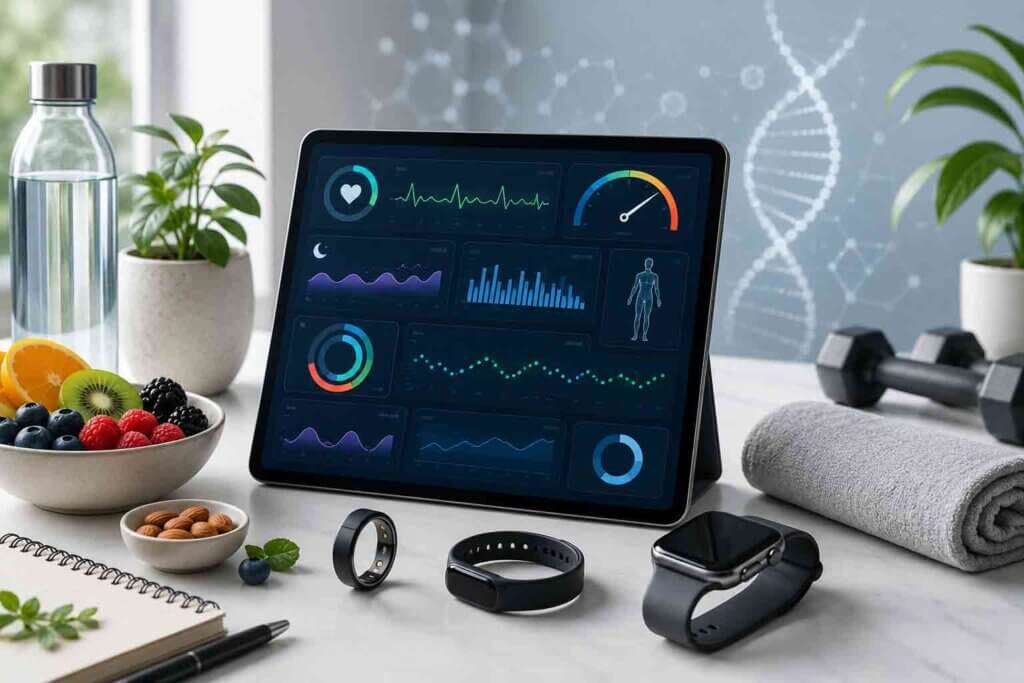
Consumer wearables rely almost entirely on photoplethysmography (PPG), accelerometers, and skin temperature sensors. That gives you:
- Heart rate and heart rate variability (HRV) — proxies for autonomic nervous system activity and recovery
- Sleep stages and duration — inferred from movement and heart rate patterns
- Steps, activity, and calorie estimates
- Blood oxygen saturation (SpO2) on some devices
- Skin temperature trends, used by some brands as a proxy for cycle tracking or illness detection
A small number of devices — mainly dedicated continuous glucose monitors (CGMs), not general fitness wearables — measure interstitial glucose directly. Ketones, insulin, and cortisol are not measured by any mainstream consumer wearable on the market today. When a fasting app displays a “ketosis” or “fat-burning” indicator, that number is typically a modeled estimate based on elapsed fasting time, not a physiological reading.
How Reliable Are the Metrics Wearables Do Measure?
This matters because even the metrics wearables are built to track vary meaningfully by device. A 2025 validation study in Physiological Reports compared nocturnal resting heart rate and HRV across multiple consumer wearables and found that proprietary algorithms, PPG sampling frequency, and sleep-stage weighting differ enough between brands to produce inconsistent outputs for the same person on the same night. A separate 2025 study in Sensors pooled five longitudinal cohorts — using smartwatches, chest straps, and smart rings — and confirmed that resting HRV, when measured consistently, does track meaningfully with physical, behavioral, and mental health outcomes, even if absolute values differ across device types.
The practical takeaway: trends over time, on the same device, are far more trustworthy than a single day’s number or a comparison between two different brands.
Does Wearable Data Change During a Fast?
Some IF-specific research exists here, though it’s still a young field. A 2021 study published in PMC examined heart rate variability in people with controlled hypertension during Ramadan intermittent fasting and found that fasting significantly raised blood glucose readings during the fasting month, while body weight and hip circumference dropped in male participants — but blood pressure, lipid panels, and overall cardiac autonomic markers stayed largely stable. That result is a useful check on hype: fasting produced real, measurable changes in some markers and no meaningful change in others, which is a more honest picture than a marketing claim that “your HRV will spike during a fast.”
A newer N-of-1 prospective trial registered with the Institute for Digital Medicine (completed mid-2025) is specifically studying wearable-tracked biomarkers across individual fasting protocols, reflecting growing research interest in personalized, device-based fasting monitoring rather than population-average claims.
The Real Reason Tracking Helps: Behavior, Not Biosensing
The strongest evidence for wearables and fasting success isn’t physiological — it’s behavioral. Self-monitoring has been described as the cornerstone of behavioral weight management for decades, and the data holds up under scrutiny. A meta-analysis of mHealth self-monitoring interventions found a moderate but consistent weight-loss effect and higher adherence rates compared with paper tracking. A 2025 randomized controlled trial published in Obesity (the SMARTER trial) found that participants who stayed more consistent with self-monitoring of diet, activity, and weight had significantly greater odds of losing 5% or more of their body weight over 12 months.
Applied to fasting specifically, this suggests the main value of a wearable or fasting app is that it keeps a visible, low-friction record of your eating window, sleep, and activity — which supports the accountability and pattern-recognition that drive adherence. The sensor doesn’t need to detect ketosis for the tracking habit to work; it needs to keep you consistent long enough for the underlying metabolic adaptations, documented by de Cabo and Mattson and others, to occur.
Where Longevity-Focused Wearables Like blēo Fit In
A newer category of wearables, including devices like the blēo ring and band, position themselves specifically around longevity and metabolic health rather than general fitness. blēo pairs its hardware with an app (marketed as “The Longevity AI”) that layers HRV, sleep, stress, and metabolic-adjacent glucose trend data into a single coaching dashboard, and it’s designed to sync alongside other ecosystems like Oura, Whoop, and Apple Watch. For someone doing intermittent fasting, that kind of consolidated view can make it easier to see whether a fasting window is coinciding with better sleep or steadier HRV over weeks, rather than checking four separate apps.
The same caveats from earlier in this article apply directly here: HRV and sleep readings are still algorithm-dependent proxies, not direct measures of autophagy or insulin sensitivity, and metabolic “glucose trend” features on non-CGM wearables are modeled rather than measured from blood. It’s also worth noting that newer entrants in this wearable category have less independent, peer-reviewed validation data than more established players like Oura or Whoop, and early third-party reviews have raised questions about hardware sourcing and accuracy claims that are worth researching before treating any single reading as clinically meaningful. Cross-checking longevity-wearable output against how you actually feel — energy, sleep quality, hunger patterns — is still the more reliable read.
How to Use Wearable Data During Intermittent Fasting (Without Overtrusting It)
- Track trends, not single readings. A week-over-week HRV trend on the same device is more meaningful than one morning’s score.
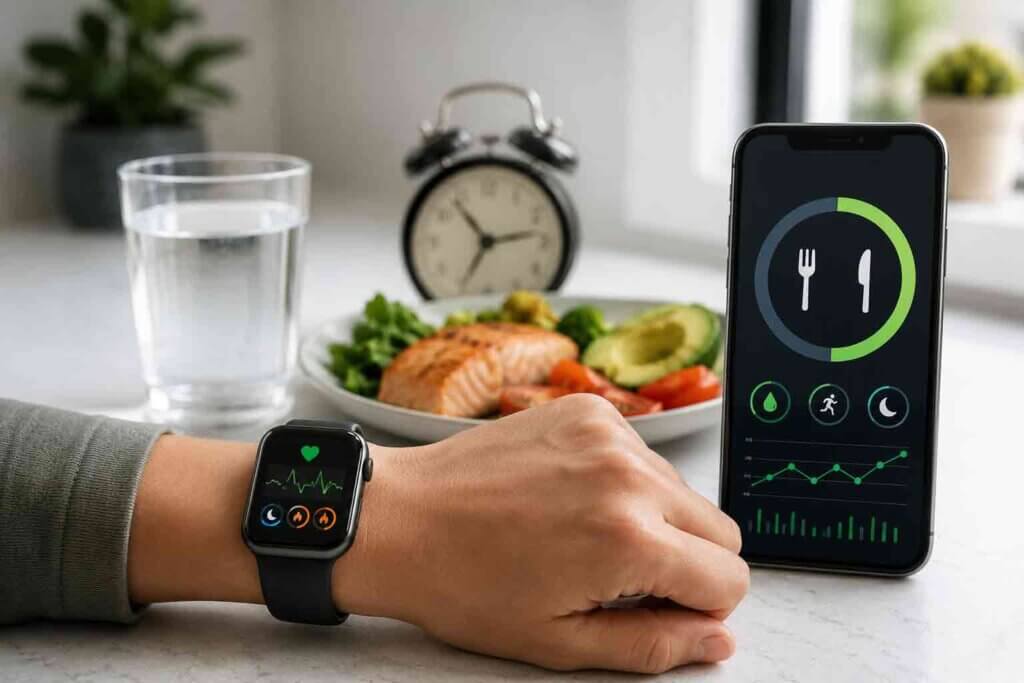
- Don’t equate a “fasting mode” countdown with a metabolic measurement. Most fasting-tracker features are manually started timers, not biosensors.
- Use sleep and recovery data to time your eating window. If your wearable consistently shows disrupted sleep on days with very late eating windows, that’s actionable, verifiable information.
- Pair wearables with a CGM only if you have a specific clinical reason to, and interpret both with guidance from a clinician, since interstitial glucose readings can lag blood glucose by several minutes.
- Treat adherence, not biosensing, as the main job of the device. The research consensus is that consistent self-monitoring — not sensor sophistication — is what correlates with better outcomes.
Frequently Asked Questions
Can a smartwatch tell if I’m in ketosis?
No. Ketosis is measured through blood, breath, or urine ketone testing. No mainstream consumer wearable directly detects ketone levels; fasting-duration countdowns are not physiological measurements.
Does HRV go up during intermittent fasting?
Evidence is mixed and individual. Some fasting research shows stable HRV and autonomic markers even when blood glucose shifts, so a single fasting session isn’t guaranteed to produce a visible HRV change on your device.
Is tracking with a wearable actually linked to better fasting results?
Indirectly, yes. Research on self-monitoring in weight management consistently shows that people who track more consistently — regardless of the specific tool — see better adherence and outcomes, which is the main mechanism behind wearable-assisted fasting.
Are longevity wearables like blēo more accurate for fasting metrics than a standard fitness tracker?
Not necessarily. They use similar PPG-based sensors to detect HRV and sleep, packaged with additional coaching and glucose-trend modeling. The underlying sensor accuracy depends on the same validation questions that apply to any consumer wearable, and independent, peer-reviewed accuracy data is more limited for newer brands.
Do I need a CGM to track intermittent fasting properly?
Not for most people doing IF for general health or weight goals. A CGM adds direct glucose data but is typically most useful for people with diabetes, prediabetes, or a specific clinical reason to monitor glucose closely, ideally under a clinician’s guidance.
References
- de Cabo, R., & Mattson, M. P. (2019). Effects of Intermittent Fasting on Health, Aging, and Disease. New England Journal of Medicine, 381, 2541–2551. https://www.nejm.org/doi/full/10.1056/NEJMra1905136
- Yuan, X., Wang, J., Yang, S., et al. (2022). Effect of Intermittent Fasting Diet on Glucose and Lipid Metabolism and Insulin Resistance: A Systematic Review and Meta-Analysis. Journal of Diabetes Research. https://www.ncbi.nlm.nih.gov/pmc/articles/PMC8970877/
- Dial, M. B., Hollander, M. E., Vatne, E. A., et al. (2025). Validation of Nocturnal Resting Heart Rate and Heart Rate Variability in Consumer Wearables. Physiological Reports. https://www.ncbi.nlm.nih.gov/pmc/articles/PMC12367097/
- Resting Heart Rate Variability Measured by Consumer Wearables and Its Associations with Diverse Health Domains in Five Longitudinal Studies. (2025). Sensors. https://www.mdpi.com/1424-8220/25/23/7147
- Hammoud, S., Saad, I., Karam, R., et al. (2021). Impact of Ramadan Intermittent Fasting on the Heart Rate Variability and Cardiovascular Parameters of Patients with Controlled Hypertension. https://www.ncbi.nlm.nih.gov/pmc/articles/PMC8024062/
- Monitoring Intermittent Fasting for Human Optimization Using Wearable Technology: An N-of-1 Study (NCT06630637). Institute for Digital Medicine. https://clinicaltrials.gov/study/NCT06630637
- Burke, L. E., et al. (2025). Adherence to Self-Monitoring and Behavioral Goals Is Associated with Improved Weight Loss in an mHealth Randomized-Controlled Trial (SMARTER). Obesity. https://pmc.ncbi.nlm.nih.gov/articles/PMC11897847/
- Effect of Behavioral Weight Management Interventions Using Lifestyle mHealth Self-Monitoring on Weight Loss: A Systematic Review and Meta-Analysis. https://www.ncbi.nlm.nih.gov/pmc/articles/PMC7400167/
- Patel, M. L., et al. (2021). Self-Monitoring via Digital Health in Weight Loss Interventions: A Systematic Review Among Adults with Overweight or Obesity. Obesity. https://onlinelibrary.wiley.com/doi/10.1002/oby.23088
- blēo — Fitness Wearables for Longevity (product and specification information). https://bleo.ai/