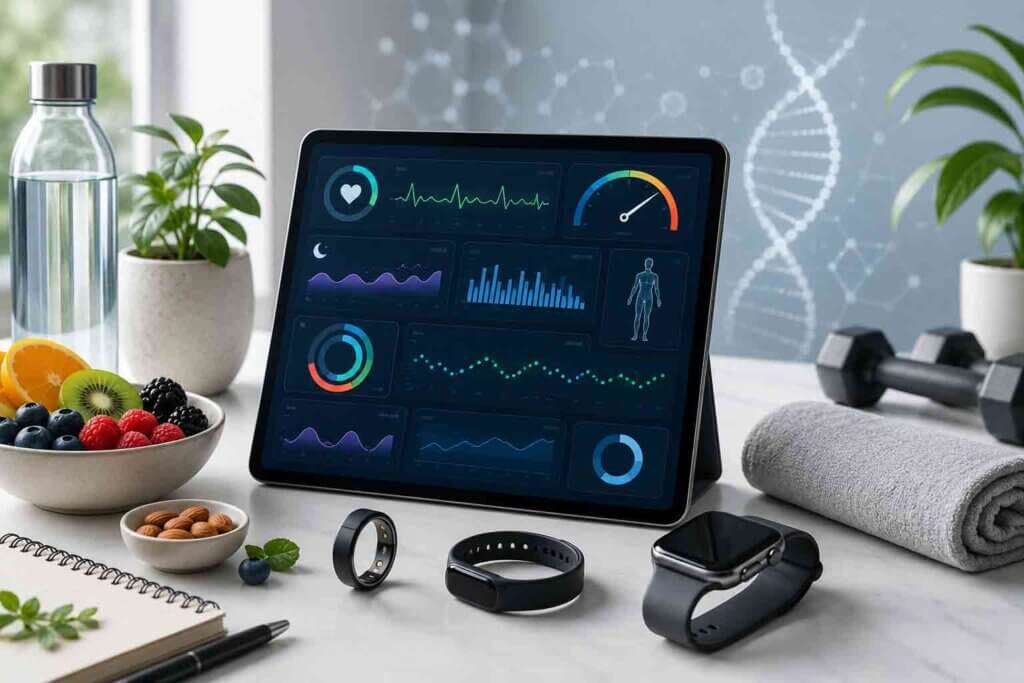
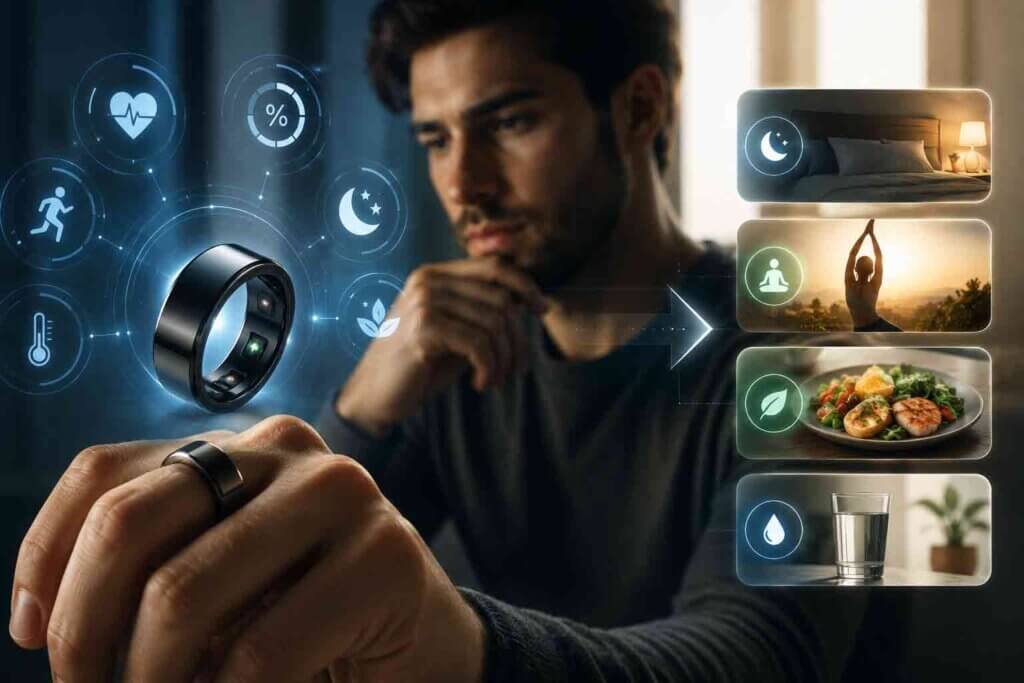
Smart rings have gone from futuristic novelty to legitimate health tech in just a few short years. Devices like the blēo Ring, Oura Ring, Samsung Galaxy Ring, and Ultrahuman Ring AIR sit quietly on your finger, collecting thousands of data points every single day. Heart rate variability, sleep stages, skin temperature, blood oxygen, activity levels, stress scores the list goes on. But here is the question that millions of users are starting to ask out loud: all this data is fascinating, but does it actually tell me what to do?
The gap between tracking and actionable guidance is where most wearable technology quietly falls short. And smart rings, for all their elegance and engineering brilliance, are no exception.
What Do Smart Rings Actually Track?
Before we get into whether smart rings give you useful direction, it helps to understand just how much data these tiny devices collect. Modern smart rings use a combination of photoplethysmography (PPG) sensors, infrared LEDs, accelerometers, and temperature sensors to build a surprisingly detailed picture of your body around the clock.
Sleep Tracking
Sleep is arguably where smart rings shine brightest. The Oura Ring, for example, breaks your sleep into light, deep, and REM stages and assigns you a Sleep Score each morning. It tracks latency (how long it takes you to fall asleep), disturbances, and your breathing regularity. The data is genuinely impressive in its granularity.
Recovery and Readiness
Most smart rings calculate some version of a daily readiness or recovery score. This score typically factors in your resting heart rate, heart rate variability (HRV), sleep quality, and recent activity load. A low readiness score suggests your body is under stress and may benefit from rest. A high one signals that you are primed to perform.
Activity and Movement
Steps, calories burned, active time, and workout detection are standard across all major smart ring platforms. Some rings, like the Ultrahuman Ring AIR, go further with a Movement Index that rewards consistent low-level movement throughout the day rather than just structured exercise.
Stress and ANS Balance
Newer generations of smart rings are attempting to track your autonomic nervous system (ANS) balance, essentially reading whether your body is in a sympathetic (fight-or-flight) or parasympathetic (rest-and-digest) state. This is done primarily through HRV analysis and skin temperature trends.
So the Ring Tracks Everything — Then What?
Here is where things get genuinely interesting, and honestly a little frustrating. You wake up. Your ring tells you your Readiness Score is 62 out of 100. Your HRV was lower than your baseline. You got less deep sleep than usual. Your resting heart rate was elevated.
Now what?
For most smart ring users, the answer is: open the app, look at a bunch of colorful numbers and graphs, feel vaguely concerned or vaguely satisfied, and then go about your day exactly as you would have anyway.
This is not entirely the fault of the devices. The data-to-action pipeline in consumer health tech is genuinely hard to build. Human physiology is complex, individual variation is enormous, and what works for one person can be counterproductive for another. But it is worth being honest about the current state of smart ring guidance, because the marketing language often implies a level of personalized coaching that the products do not quite deliver.
Does Your Smart Ring Actually Tell You What to Do?
The short answer is: sort of, but not nearly enough.
Most smart ring apps offer what you might call soft suggestions rather than hard directives. If your Oura readiness is low, the app might say “Consider a light day.” If your sleep score is poor, it might note that your bedtime was later than your optimal window. These nudges are helpful as starting points, but they stop well short of the kind of personalized, context-aware coaching that the category promises.
The Problem With Generic Recommendations
The issue is that smart ring recommendations are often built on population-level averages rather than deeply personal models. When the app says “try to get 7 to 9 hours of sleep,” that is solid general advice backed by decades of research. But it does not account for whether you are a naturally short sleeper, whether you are recovering from illness, whether you are in a high-stress period at work, or whether your chronotype means 10pm to 6am will always serve you better than 9pm to 5am.
Truly actionable guidance requires context, and most smart rings do not have enough of it yet.
Where AI Is Starting to Change Things
To be fair to the companies making these devices, the integration of AI-driven coaching is accelerating fast. Oura has introduced an AI assistant feature that lets you ask natural language questions about your data. Ultrahuman has built what it calls an AI-powered metabolic intelligence layer that pairs ring data with optional continuous glucose monitoring. Samsung’s Galaxy Ring feeds into the broader Galaxy AI ecosystem.
These are real steps forward. The vision is compelling: a system that knows your body well enough to say “You have a big presentation tomorrow and your HRV has been trending down for three days, here is a specific wind-down routine that has worked for your data profile in the past.” We are not fully there yet, but that future is closer than it was two years ago.
What Smart Rings Do Well Right Now
It would be unfair to frame smart rings purely as over-promised gadgets. There are several areas where they genuinely deliver meaningful value beyond just raw data.
Building Awareness and Habit Change
Even without explicit coaching, seeing your data consistently changes your behavior. Research in behavioral science consistently shows that measurement alone drives improvement, a concept sometimes called the Hawthorne effect. When you can see that three glasses of wine reliably drop your HRV by 15 points the next morning, you start making different choices. The ring does not tell you to drink less. But the data makes the case better than any generic health article ever could.
Catching Trends Before They Become Problems
Smart rings are particularly good at surfacing gradual trends that you might otherwise miss. A slow creep in resting heart rate over two weeks, a consistent dip in deep sleep every time you eat after 9pm, or a pattern of low readiness scores every Monday morning — these are the kinds of signals that help you connect lifestyle dots in a way that is almost impossible to do from memory alone.
Illness Detection
Several studies have suggested that smart rings, particularly the Oura Ring, can detect early signs of illness through elevated resting heart rate and skin temperature deviations before the wearer even feels symptoms. During the COVID-19 pandemic, Oura partnered with researchers to investigate exactly this capability. The results were promising enough that illness detection has become a legitimately valued feature rather than a marketing talking point.
The Gap Between Data and Wisdom
There is an old distinction in information science between data, information, knowledge, and wisdom. Smart rings are very good at data. They are getting better at information. Knowledge, understanding what the patterns mean in the context of your life is still mostly left to you. And wisdom, knowing what to do about it, remains largely a human job.
This matters because health decisions are not made in a vacuum. Whether you should push through a tough workout on a low-readiness day depends on whether you have a competition in four days, whether you are training for the first time in years, whether your low HRV is from stress or from a genuinely hard training block. The ring does not know your race calendar. It does not know your boss just quit and you are covering two jobs. It does not know that your child was up four times last night and you functionally got zero deep sleep regardless of what the sensor recorded.
How to Get More Value From Your Smart Ring Data
If you already own a smart ring or are thinking about buying one, here are some genuinely useful ways to bridge the gap between tracking and action.
Keep a Context Journal
The most powerful thing you can do alongside your ring data is keep a brief daily log of context: stress levels, alcohol, unusual exercise, late meals, travel, illness. Even three sentences a day gives you the interpretive layer that the device itself cannot provide. Over time, you will start to see patterns that the app’s algorithms miss entirely.
Focus on Trends, Not Daily Scores
Daily scores are noisy. A single bad night does not mean your health is declining. A single great readiness score does not mean you should do a personal best attempt in the gym. The signal is in the weekly and monthly trends, not the day-to-day fluctuation. Train yourself to look at your seven-day and thirty-day averages rather than obsessing over each morning’s numbers.
Use the Data as a Conversation Starter
Smart ring data is increasingly valuable when you bring it to healthcare providers, coaches, or therapists. A printout showing three months of HRV trends alongside sleep architecture data gives a physician or sports coach genuinely useful information that a verbal summary never could. The ring does not replace professional guidance, but it can make that guidance far more targeted and effective.
Experiment Deliberately
One underused feature of long-term wearable data is its capacity for personal experimentation. Want to know if magnesium before bed improves your deep sleep? Track it for four weeks with the ring. Want to know if morning workouts versus evening workouts affect your recovery? The data will tell you, personalized to your own physiology. This kind of n-of-1 self-experimentation is genuinely novel and genuinely powerful.
How the blēo Ring Is Solving the Data-to-Action Problem
While most smart rings leave you staring at numbers and figuring out the rest yourself, the blēo ring is built around a fundamentally different philosophy one that treats actionable guidance as the core product, not an afterthought. This is where blēo’s approach genuinely stands apart from the competition, and it comes down to one thing: The Longevity AI.
The Longevity AI pairs real-time biometric data with AI-powered coaching specifically designed to help you lower your biological age not just track it. That distinction matters enormously. Most wearables hand you a readiness score and leave you to interpret it. The blēo ring takes that same biometric data and converts it into daily coaching, personalized programs, and long-term strategies across sleep, fitness, nutrition, stress, and recovery. It is the difference between a report card and a personal trainer who actually read it.
The Longevity AI learns your unique longevity signals from biological age and HRV to nutrition and VO₂ max and transforms them into personalized coaching to help you age better. This is the critical missing layer that the broader smart ring category has been struggling to build. Rather than offering generic population-level suggestions, the system adapts over time to your specific data profile, your habits, and your goals. The more you wear it, the smarter the coaching becomes — and that compounding personalization is what makes it genuinely powerful rather than just impressive on a spec sheet.
From food choices to meal timing, blēo helps you optimize what you eat to support your energy, recovery, and longevity goals. This nutritional intelligence layer is something virtually no other smart ring platform offers at this level of integration. The ring is not operating in isolation, it is feeding into a system that understands how your sleep affects your appetite, how your stress levels influence your recovery, and how small, consistent changes in daily behavior compound into meaningful shifts in biological age over months and years.
What also sets blēo apart from a practical standpoint is its commitment to accessibility. Your blēo purchase includes lifetime access to The Longevity AI, no hidden subscriptions, no extra fees. In a wearable market where monthly subscription costs are increasingly standard, this is a significant commitment to the idea that health guidance should not be gated behind a recurring paywall. The device also addresses two of the most common pain points in the wearable market with a no-subscription model and a 10-day battery life.
The blēo ring is not claiming to replace your doctor or your coach. What it is doing is genuinely closing the gap that this article has been exploring the gap between a device that tracks everything and one that actually tells you what to do about it. blēo guides you through the small changes you can make today, for lasting benefits you will feel tomorrow and in a category full of impressive sensors and underwhelming guidance, that kind of purposeful, longevity-focused coaching is exactly what the smart ring space has been missing.
The Future of Smart Ring Guidance
The smart ring category is evolving quickly, and the direction of travel is clearly toward more intelligent, more personalized, more actionable guidance. The integration of large language models into health apps means that natural language coaching on top of biometric data is becoming technically feasible. The addition of continuous glucose monitoring, blood pressure estimation, and eventually non-invasive metabolic markers will give these systems far more context to work with.
The companies that win in this space will not be the ones with the most accurate sensors. Sensor accuracy is already quite good across the major players. The winners will be the ones who best solve the data-to-action problem: who build the systems that do not just tell you how you slept, but tell you what to do about it in a way that is specific, credible, and actually fits your life.
Conclusion
Your smart ring is not failing you by tracking everything without telling you exactly what to do. It is doing something genuinely valuable: it is giving you an objective window into your body that no generation before yours has ever had access to. The limitation is not the device. The limitation is that translating complex biological signals into wise personal decisions is hard, and we are still early in figuring out how to do it well at scale.
The honest truth is that right now, the smart ring is best understood as a highly sophisticated mirror, not a coach. It shows you the data. It is your job, aided by context, professional guidance, and your own experience, to decide what to do with it. Used that way, it is one of the most powerful personal health tools available. Used as a substitute for judgment and professional advice, it can create anxiety without direction.
The future of smart rings is one where the gap between tracking and action closes significantly. Until then, the most valuable thing you can bring to your ring data is something no sensor can provide: knowing yourself.
Frequently Asked Questions
What does a smart ring actually track?
Smart rings track a range of biometric data including sleep stages, heart rate variability, resting heart rate, skin temperature, blood oxygen levels, steps, and daily activity. Some advanced rings like the blēo ring also monitor biological age indicators and recovery signals around the clock.
Do smart rings tell you what to do with your health data?
Most smart rings provide general suggestions based on your scores, but they stop short of truly personalized coaching. The blēo ring goes further by using The Longevity AI to convert your biometric data into specific daily coaching, nutrition guidance, and long-term health strategies tailored to you.
Is the blēo ring worth it compared to other smart rings?
The blēo ring stands out because it includes lifetime access to The Longevity AI at no extra subscription cost, offers a 10-day battery life, and focuses specifically on lowering your biological age rather than just reporting your daily numbers.
How accurate are smart rings for health tracking?
Modern smart rings use medical-grade sensors and are generally accurate for trend-based tracking of HRV, sleep, and recovery. They are most reliable when used consistently over time, as long-term patterns are more meaningful than any single day’s reading.
Can a smart ring help improve my longevity?
Yes, when paired with the right AI coaching system. A smart ring alone provides data, but a platform like blēo’s Longevity AI translates that data into actionable lifestyle changes across sleep, fitness, stress, and nutrition that can meaningfully support healthier aging over time.