
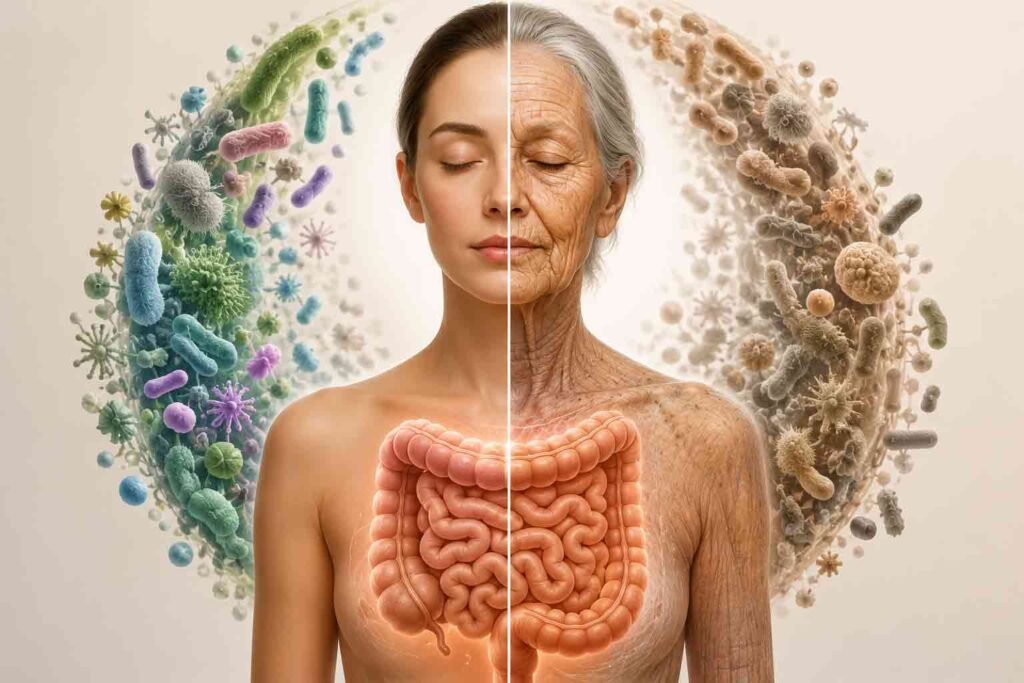
Quick answer: Your gut microbiome — the trillions of bacteria, fungi, and other microbes living in your digestive tract — shapes how you age. Research on centenarians shows that people who live past 100 tend to carry more diverse gut bacteria that produce protective compounds, including specific bile acids and short-chain fatty acids, which lower inflammation and defend against harmful pathogens. A less diverse, imbalanced microbiome, by contrast, is linked to “inflammaging,” the chronic low-grade inflammation that drives many age-related diseases. Diet, especially fiber and fermented foods, is one of the most direct ways to influence this relationship.
Most people think about aging in terms of wrinkles, joint pain, or memory. Few think about their gut. But a growing body of research suggests the trillions of microorganisms living in your intestines may be one of the most powerful, and most modifiable, factors in how you age.
Scientists studying centenarians — people who live past 100 — keep finding the same pattern. These individuals don’t just have “good genes.” They tend to carry gut microbiomes that look meaningfully different from those of younger, less healthy populations. Their microbial communities are more diverse, more stable, and capable of producing compounds that fight inflammation and resist infection.
This article breaks down what the research actually shows about the gut-longevity connection: how the microbiome changes as we age, the mechanisms linking gut bacteria to biological aging, what centenarian studies reveal, and which evidence-backed dietary strategies appear to support a healthier, longer-lived gut.
What Is the Gut Microbiome, and Why Does It Matter for Aging?
The gut microbiome is the community of trillions of bacteria, viruses, fungi, and other microorganisms that live primarily in the large intestine. It functions almost like an additional organ, helping digest food, train the immune system, produce vitamins, and regulate inflammation throughout the body.
Researchers increasingly describe the gut microbiome as a lifelong companion that shapes health from infancy through old age, with its composition shifting continuously in response to diet, environment, medication, and the aging process itself. That relationship runs in both directions: aging changes the microbiome, and the microbiome, in turn, appears to influence how quickly or slowly a person ages biologically.
A 2025 review in the Journal of Biomedical Science describes this as a two-way relationship shaped by diet, lifestyle, hormones, and immune function, operating partly through the gut-muscle axis and the gut-brain axis in later life. The authors note that long-lived individuals tend to share specific microbiome signatures, including higher diversity, more beneficial bacterial species, and stronger gut barrier function.
How the Gut Microbiome Changes as You Age
Diversity tends to decline
The dominant pattern seen across aging research is a gradual loss of microbial diversity. A 2025 metagenomic study published in Frontiers in Microbiology points to this as the prevailing hypothesis in the field: gut microbiota diversity diminishes with natural aging and is closely tied to frailty in older adults.
Lower diversity matters because a more varied microbial community is generally more resilient. It can better resist disruption from illness, antibiotics, or dietary changes, and it produces a broader range of beneficial metabolites. When diversity narrows, the gut becomes more vulnerable to overgrowth by less favorable species.
Beneficial bacteria and their byproducts decrease
As people age, populations of certain beneficial bacteria — including short-chain fatty acid (SCFA) producers from the Lachnospiraceae family — tend to decline. SCFAs like butyrate are important because they fuel the cells lining the colon, help maintain the gut barrier, and have anti-inflammatory effects throughout the body.
Interestingly, some research has identified age-related increases in certain other organisms, such as the archaeon Methanobrevibacter smithii, which appears to interact with butyrate producers in ways that may help offset some of this age-related decline, according to a 2025 metagenomic study on healthy aging populations. The exact mechanisms are still being investigated.
The gut barrier becomes more permeable
With age, the intestinal lining that normally keeps gut bacteria and their byproducts contained can become “leakier.” This allows bacterial fragments to enter the bloodstream more easily, triggering low-grade immune activation. This process is one of the proposed drivers of a phenomenon researchers call inflammaging.
Inflammaging: The Missing Link Between Gut Health and Biological Age
Inflammaging refers to the chronic, low-grade inflammation that tends to rise steadily with age, even in the absence of acute infection. It’s considered one of the central drivers of age-related disease, contributing to conditions ranging from cardiovascular disease to neurodegeneration to frailty.
A 2025 review published in Aging: Challenges and Therapeutic Opportunities explains that as the gut microbiome shifts toward dysbiosis, an imbalance in microbial composition, it contributes directly to increased inflammation, weakened immune defenses, and metabolic disruption. The review specifically ties inflammaging to gut microbial alterations and links it to neurodegenerative disease, cardiovascular conditions, obesity, and diabetes.
In other words, the gut may not just reflect the aging process. It may actively participate in driving it, through the steady release of inflammatory signals tied to microbial imbalance.
What Centenarian Studies Reveal About Gut Bacteria and Longevity
If inflammaging represents the downside of gut dysbiosis, centenarian research represents the upside — a look at what a “successfully aged” gut might look like.
Unique bile acids may protect against infection
One of the most notable findings in this field comes from a study led by Kenya Honda’s team at Keio University, published in Nature. Researchers compared the gut microbiomes of centenarians (averaging 107 years old), adults aged 85 to 89, and younger adults aged 21 to 55.
Centenarians carried a distinct gut microbiome enriched in bacteria capable of producing unique secondary bile acids, several isoforms of lithocholic acid. One in particular, isoallo-lithocholic acid, had not previously been characterized. The researchers traced its production to bacteria in the Odoribacteraceae family, along with the species Parabacteroides merdae.
When tested, this bile acid showed strong antimicrobial activity against gram-positive, multidrug-resistant pathogens, including Clostridioides difficile and vancomycin-resistant Enterococcus. The implication is significant: the gut bacteria found in extremely long-lived people may help protect them from dangerous infections that often affect older, more vulnerable populations.
More diversity, more resilience
Separate research on Chinese centenarian populations, including a 2022 study in npj Biofilms and Microbiomes examining residents of Jiaoling, a recognized longevity region, found that centenarians carried a core set of beneficial microbial taxa, including Akkermansia, Lactobacillus, and SCFA-producing bacteria, along with higher overall microbial diversity compared to younger cohorts.
The researchers also identified antioxidant activity linked to gut-resident Lactobacillus strains in these populations, suggesting the microbiome may help buffer against oxidative stress, another hallmark of biological aging.
Correlation, not yet proof of causation
It’s worth being direct about a limitation here: most centenarian studies are observational. They show that long-lived people have distinctive gut bacteria, but they can’t yet fully prove that those bacteria caused the longevity, rather than simply reflecting a lifetime of healthier habits, genetics, or environment. Researchers studying the Keio findings have called for longitudinal studies and animal models to validate the causal relationship before any therapeutic claims are made.
The Gut-Brain Axis and Cognitive Aging
The gut doesn’t just talk to the immune system. It also communicates directly with the brain through what researchers call the gut-brain axis, a network involving the vagus nerve, immune signaling, and microbial metabolites.
Because this axis plays a role in mood regulation, cognitive function, and neuroinflammation, disruptions in gut microbial balance have been increasingly connected to age-related cognitive decline and neurodegenerative conditions. The 2025 review in the Journal of Biomedical Science specifically points to the gut-brain axis, alongside the gut-muscle axis, as a pathway through which the microbiome regulates aging in later life.
This is still an emerging area, but it reframes gut health as something that extends well beyond digestion, touching memory, mood, and long-term brain resilience.
Can You Actually Change Your Gut Microbiome to Support Longevity?
This is the question most people actually want answered, and the honest response is: partially, and the evidence is strongest for a handful of specific interventions.
Fermented foods show measurable effects on diversity and inflammation
One of the most rigorous human trials on this topic comes from Stanford Medicine, led by Justin and Erica Sonnenburg alongside Christopher Gardner, and published in Cell in 2021. Researchers randomly assigned 36 healthy adults to a 10-week diet emphasizing either high-fiber foods or fermented foods like yogurt, kefir, fermented cottage cheese, kimchi, and kombucha.
The results were unexpected. The fermented-food group showed a significant increase in overall gut microbial diversity, along with a broad decrease across 19 measured inflammatory proteins. The high-fiber group, despite researchers’ expectations, showed no significant change in microbial diversity over the same period, though fiber remained important for feeding existing beneficial bacteria.
Justin Sonnenburg called it one of the first clear demonstrations that a simple dietary change can reliably reshape the microbiome across a group of healthy adults. The researchers have since suggested this effect may be even more relevant for older adults, whose microbial diversity has already started to narrow, since restoring diversity through diet could help counter some age-related decline. Follow-up studies in this area are ongoing.
Fiber still matters, but timing and gut readiness matter too
Fiber remains foundational to gut health because it feeds fiber-degrading bacteria, which in turn produce SCFAs like butyrate. The Stanford researchers noted that a longer intervention period might have allowed participants’ microbiomes more time to adapt to increased fiber intake. This suggests fiber’s benefits may take longer to show up, especially in a modern population whose microbiomes are often already low in fiber-degrading species due to industrialized diets.
Probiotics, prebiotics, and postbiotics as targeted tools
Beyond whole foods, researchers are studying more targeted microbiome interventions:
- Probiotics introduce live beneficial bacteria strains directly.
- Prebiotics are fibers and compounds that selectively feed beneficial bacteria already present.
- Postbiotics are the beneficial byproducts bacteria produce, such as SCFAs, which can sometimes be supplemented directly.
A comprehensive 2025 review in PMC on microbiome-based therapeutics for healthier aging highlights fiber- and polyphenol-rich diets, probiotics, prebiotics, postbiotics, and fecal microbiota transplantation (FMT) as strategies with potential to restore microbial balance in aging populations. The review notes these interventions appear to work by supporting nutrient production, strengthening the gut’s epithelial barrier, and improving mucus layer integrity, all of which contribute to a more resilient gut environment.
FMT, in which microbiota from a healthy donor is transferred to a recipient, is already an established treatment for severe C. difficile infections and is being explored as a possible strategy for restoring more youthful microbial balance, though this remains experimental for general aging support.
Why personalization matters
Not every intervention works the same way for every person. At the Nutra Healthspan Summit in November 2025, microbiome researcher Sean Gibbons argued that the goal shouldn’t be “rejuvenating” the gut to look like it did decades earlier, but optimizing it for each individual’s current biology. He pointed to the need for prospective clinical trials testing personalized, microbiome-informed nutrition against standard approaches like the Mediterranean diet before such interventions can be confidently recommended.
This is a useful corrective to some of the more sweeping claims in the wellness space. The science supports meaningful, food-based strategies for supporting gut diversity and lowering inflammation. It does not yet support the idea of a single supplement or protocol that reliably “reverses” gut aging.
Beyond Diet: Other Lifestyle Factors That Shape Gut Aging
Diet gets most of the attention in gut-longevity research, but it’s not the only lever. Several other everyday factors appear to influence how the microbiome ages.
Antibiotic use and medication history
Antibiotics are among the most disruptive forces on gut microbial diversity, sometimes taking months to recover from after a single course. Because older adults are prescribed antibiotics more frequently, cumulative antibiotic exposure over a lifetime may partly explain why microbial diversity tends to narrow with age. Researchers reviewing aging-associated gut microbiome changes specifically flag medication use, alongside diet and antibiotics, as a factor shaping longevity-related microbial composition.
Physical activity and the gut-muscle axis
Regular physical activity has been associated with greater microbial diversity and higher levels of SCFA-producing bacteria in several observational studies. This connects to what researchers call the gut-muscle axis, a signaling relationship in which gut-derived metabolites influence muscle maintenance, and muscle activity in turn appears to shape microbial composition. Since muscle loss, or sarcopenia, is itself a hallmark of aging, this bidirectional relationship is drawing increasing research interest as a potential intervention point.
Sleep and circadian rhythm
Gut bacteria follow circadian patterns, and disrupted sleep has been linked to shifts in microbial composition that favor pro-inflammatory species over beneficial ones. While this research is still developing in humans, animal studies suggest that irregular sleep patterns can measurably alter gut community structure within days, which may compound over years into more persistent dysbiosis.
Chronic stress
Psychological stress activates the same gut-brain communication pathways involved in cognitive aging, and chronic stress has been associated with reduced microbial diversity and increased intestinal permeability in multiple studies. Because stress tends to accumulate and compound over a lifetime, some researchers view stress management as an underappreciated component of long-term gut health, alongside diet and physical activity.
Environmental and geographic factors
Some of the most striking centenarian research comes from specific “longevity regions,” such as Jiaoling in China, where local diet, environment, and possibly generational microbial transmission all appear to contribute to distinctive gut profiles. This raises an open question in the field: how much of the centenarian microbiome signature is shaped by individual lifestyle choices, versus shared regional factors like local food systems, water sources, or even household microbial exchange between family members. Researchers have not yet fully disentangled these variables.
What the Research Doesn’t Yet Prove
It’s worth being clear about the boundaries of current evidence, since gut health is an area prone to overstatement.
Most of the strongest findings connecting specific bacteria to longevity, including the centenarian bile acid research, are correlational. They establish that certain microbial signatures show up more often in long-lived, healthy populations. They don’t yet prove that manipulating your own microbiome to mimic those signatures would extend your lifespan or meaningfully slow aging.
Human intervention trials, like the Stanford fermented-food study, are more direct evidence of cause and effect, but they typically measure intermediate outcomes, such as microbial diversity or inflammatory markers, rather than lifespan itself, which would require decades to study in humans. Researchers studying microbiome-based therapeutics for aging have explicitly noted that the precise role of specific bacterial taxa and their metabolites in healthy aging remains only partly understood, particularly whether these signatures are innate to certain individuals or genuinely shaped by lifestyle.
This doesn’t undermine the value of the research. It simply means the responsible takeaway is “these habits are associated with markers of a healthier gut and lower inflammation,” not “this specific bacterium will make you live to 100.”
Practical Takeaways: Supporting Your Gut as You Age
Based on the current evidence, a few strategies stand out as reasonably well-supported:
- Add fermented foods regularly. Yogurt, kefir, kimchi, sauerkraut, and other fermented vegetables were directly linked to increased microbial diversity and reduced inflammation in controlled research.
- Keep fiber intake consistent, not just occasional. Fiber feeds the bacteria responsible for producing SCFAs, which support gut barrier integrity, even if its diversity effects take longer to appear.
- Favor diverse plant foods over a narrow rotation. A wider variety of plant fibers and polyphenols appears to support a broader range of beneficial bacterial species.
- Be cautious with unnecessary antibiotic use, since antibiotics are one of the most disruptive forces on microbial diversity.
- Treat probiotic supplements as targeted tools, not blanket solutions. Strain-specific effects vary, and research in this area is still maturing.
None of these are guarantees against aging. But they represent the interventions with the clearest human evidence behind them so far.
Frequently Asked Questions
Does gut health really affect how fast you age?
Growing research suggests it does, at least partially. Gut bacteria influence chronic inflammation, immune function, and metabolic health, all of which are closely tied to biological aging. Centenarian studies show distinct, more diverse microbiomes compared to younger or less healthy populations, though researchers are still working to confirm how much of this is cause versus consequence.
What bacteria are linked to longevity?
Research has pointed to several groups, including Odoribacteraceae and Parabacteroides merdae, which produce protective secondary bile acids found at higher levels in centenarians, along with SCFA-producing bacteria like those in the Lachnospiraceae family and beneficial species such as Akkermansia and Lactobacillus.
Can changing your diet actually change your gut microbiome? Yes, and relatively quickly. A Stanford clinical trial found that just 10 weeks of increased fermented food intake measurably increased gut microbial diversity and lowered markers of inflammation in healthy adults.
Is fiber or fermented food better for gut health?
They serve different roles. Fermented foods showed a stronger, faster effect on microbial diversity in controlled research, while fiber continues to feed existing beneficial bacteria and support SCFA production over time. Most researchers recommend including both rather than choosing one.
What is inflammaging?
Inflammaging is the chronic, low-grade inflammation that tends to increase with age even without active infection. It’s considered a major contributor to age-related diseases, and gut dysbiosis is one of the pathways researchers believe helps drive it.
Should older adults take probiotics for longevity?
Probiotics may help support gut balance, but current research suggests effects are strain-specific and highly individual. Experts increasingly favor personalized, food-first approaches over blanket probiotic recommendations, pending more clinical trial evidence.
Conclusion
The relationship between the gut microbiome and aging isn’t a wellness trend. It’s an active, fast-moving area of scientific research, backed by centenarian studies, clinical trials, and metagenomic analysis across multiple populations. The clearest signal so far is that microbial diversity and specific protective bacteria, from bile-acid-producing Odoribacteraceae to SCFA-generating Lachnospiraceae, appear again and again in people who age well.
What you can act on today is more modest than a miracle protocol: consistent fiber intake, regular fermented foods, and a genuinely varied diet appear to give your gut the best shot at staying diverse and resilient. The research on precise, personalized microbiome interventions is still developing. Until it matures, the food-based fundamentals remain the most evidence-backed place to start.
Sources
- Sato, Y., et al. “Novel bile acid biosynthetic pathways are enriched in the microbiome of centenarians.” Nature, 2021. https://www.nature.com/articles/s41586-021-03832-5
- Wastyk, H.C., et al. “Gut-microbiota-targeted diets modulate human immune status.” Cell, 2021 (Stanford Medicine study). https://pmc.ncbi.nlm.nih.gov/articles/PMC9020749/
- “From dysbiosis to longevity: a narrative review into the gut microbiome’s impact on aging.” Journal of Biomedical Science, 2025. https://link.springer.com/article/10.1186/s12929-025-01179-x
- “Aging through the lens of the gut microbiome: Challenges and therapeutic opportunities.” ScienceDirect, 2025. https://www.sciencedirect.com/science/article/pii/S2950307825000244
- “Gut microbiome dynamics and functional shifts in healthy aging: insights from a metagenomic study.” Frontiers in Microbiology, 2025. https://www.frontiersin.org/journals/microbiology/articles/10.3389/fmicb.2025.1629811/full
- “Microbiome-based therapeutics towards healthier aging and longevity.” Genome Medicine / PMC, 2025. https://pmc.ncbi.nlm.nih.gov/articles/PMC12220006/
- “Gut microbiota as an antioxidant system in centenarians associated with high antioxidant activities of gut-resident Lactobacillus.” npj Biofilms and Microbiomes, 2022. https://www.nature.com/articles/s41522-022-00366-0
- Daniells, S. “Anti-aging strategies may not work for the gut microbiome, says expert.” NutraIngredients, November 2025. https://www.nutraingredients.com/Article/2025/12/01/why-anti-aging-strategies-may-fail-for-gut-health/
- “A fermented-food diet increases microbiome diversity and lowers inflammation, study finds.” Stanford Medicine News, 2021. https://med.stanford.edu/news/all-news/2021/07/fermented-food-diet-increases-microbiome-diversity-lowers-inflammation.html
- “The gut microbiota and aging: interactions, implications, and interventions.” Frontiers in Aging, 2025. https://www.frontiersin.org/journals/aging/articles/10.3389/fragi.2025.1452917/full
This article is for informational purposes only and does not constitute medical advice. Consult a qualified healthcare provider before making significant changes to your diet or supplement routine, particularly if you have an existing health condition.