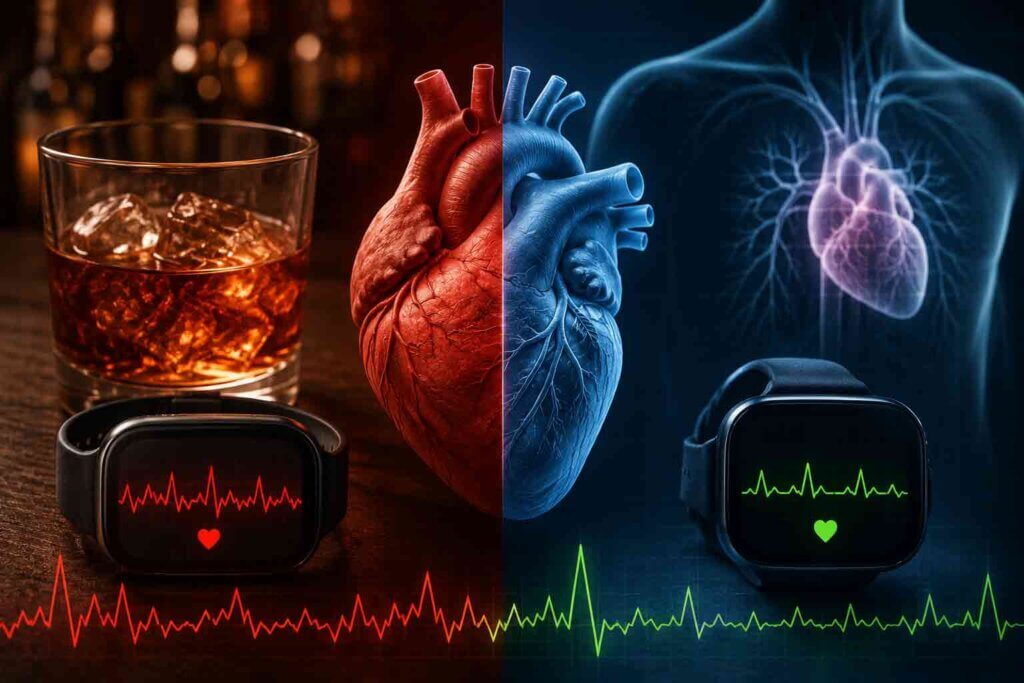
Alcohol suppresses heart rate variability (HRV) immediately after consumption — and the disruption lasts far longer than most people realize. A single drink can reduce HRV by 2.4 to 7 milliseconds. Two drinks cut total HRV by 28 to 33%. Even moderate drinking on one evening can suppress your HRV for up to five days afterward. Chronic heavy drinkers show persistently low HRV even after several days of abstinence. This article explains the physiological mechanism behind that suppression, what the latest wearable data shows, how long recovery takes, and what the research says about reversibility
TL;DR — Key Takeaways
- One standard drink lowers HRV by 2.4–7 ms; two drinks lower total HRV by 28–33%
- Alcohol shifts the autonomic nervous system from parasympathetic (rest) to sympathetic (stress) dominance
- HRV suppression from a single evening of drinking can last 2–5 days
- Oura Ring data from 600,000+ members showed a 15.6% mean HRV drop (10.8 ms) on drinking nights
- WHOOP data from collegiate athletes found 74% had suppressed HRV the day after drinking; 19% were still below baseline 3 days later
- Four weeks of abstinence significantly increases HRV indices in alcohol-dependent individuals
- HRV is now being studied as a biomarker for alcohol craving and relapse risk
What Is Heart Rate Variability?
Heart rate variability is the variation in time — measured in milliseconds — between consecutive heartbeats. A common misconception is that a steady, consistent heartbeat is the sign of a healthy heart. The opposite is true. A healthy heart constantly adjusts the interval between beats in response to breathing, movement, stress, and recovery demands.
That variation is regulated by the autonomic nervous system (ANS), which operates in two counterbalancing modes:
- Parasympathetic nervous system (PNS): The “rest and digest” branch. High PNS activity produces higher HRV and signals effective recovery.
- Sympathetic nervous system (SNS): The “fight or flight” branch. High SNS activity reduces HRV and signals stress or physiological strain.
HRV is typically measured using several metrics. RMSSD (root mean square of successive differences) is the most widely used for short-term measurement and reflects parasympathetic tone most directly. SDNN (standard deviation of NN intervals) captures overall HRV across a longer window. pNN50 measures the percentage of consecutive heartbeats that differ by more than 50 milliseconds. High-frequency (HF) power and the LF/HF ratio are used in frequency-domain analysis to quantify the balance between sympathetic and parasympathetic influence.
Consumer wearables including the Oura Ring, WHOOP, Garmin, and Apple Watch now measure HRV during sleep. A 2025 independent peer-reviewed validation study published in Physiological Reports found the Oura Ring Gen 4 achieved a concordance correlation coefficient (CCC) of 0.99 against an ECG reference — effectively medical-grade accuracy for sleep HRV. WHOOP 5.0 achieved a CCC of 0.94.
The Autonomic Mechanism: Why Alcohol Suppresses HRV
Alcohol is an ethanol-based central nervous system depressant — but its effects on the autonomic nervous system are stimulatory rather than calming.
When you consume alcohol, four overlapping mechanisms suppress HRV:
1. Direct Sympathetic Activation
Alcohol and its primary metabolite, acetaldehyde, activate the sympathetic nervous system. The body processes ethanol as a toxin, triggering a physiological stress response. This shifts autonomic balance toward SNS dominance and away from the parasympathetic activity that supports HRV.
Research published in the American Journal of Physiology — Heart and Circulatory Physiology found that one standard drink had no measurable effect on HRV in healthy subjects, but two drinks increased heart rate by an average of 5.4 to 5.7 beats per minute and reduced total HRV by 28 to 33%. HF spectral power — the frequency-domain marker most directly tied to parasympathetic activity — dropped significantly, while the LF/HF ratio (sympathetic dominance indicator) rose.
2. Sleep Architecture Disruption
The majority of HRV recovery happens during sleep, specifically during slow-wave (deep) sleep when the parasympathetic system restores autonomic balance. Alcohol suppresses REM sleep in the first half of the night and disrupts sleep continuity in the second half — the window when restorative parasympathetic tone is highest.
Because blood alcohol concentrations during sleep directly inhibit deep sleep, the body cannot undergo normal overnight recovery, even when total sleep hours look normal on a tracker. This is why wearable users frequently report low HRV scores after drinking nights despite seeing acceptable sleep duration data.
3. Dehydration and Cardiovascular Load
Alcohol is a diuretic. For every standard drink consumed, the body loses more fluid than it takes in — concentrating blood and forcing the cardiovascular system to compensate by increasing heart rate and vascular resistance. This elevated cardiovascular load suppresses HRV by maintaining sympathetic tone through the night.
4. Liver Metabolic Burden
The liver processes roughly one standard drink per hour. If alcohol is consumed faster than that rate, residual ethanol and acetaldehyde remain in circulation into the sleep period. The metabolic burden of processing these compounds sustains the physiological stress response, keeping the sympathetic nervous system activated and HRV suppressed hours past the point of feeling sober.
What the Data Shows: Wearables at Scale
The largest real-world dataset on alcohol and HRV comes from Oura, which analyzed de-identified aggregate data from over 600,000 members between January and October 2025.
On nights when members tagged alcohol consumption:
- Average HRV fell by 10.8 milliseconds — a 15.6% mean decrease compared to surrounding alcohol-free nights
- Resting heart rate increased by 9.6%
- Lowest overnight resting heart rate rose by 8.2%
Lower HRV and higher resting heart rate together reflect a shift toward sympathetic dominance and delayed recovery — the body working harder during a period when it should be repairing.
WHOOP’s data from collegiate athletes produced parallel findings. In a study of the platform’s members:
- 74% showed suppressed recovery metrics the day after reporting alcohol consumption
- 29% were still below HRV baseline two days later
- 19% remained below baseline three days after drinking
- Some members’ HRV remained suppressed for four to five days
These figures reflect a range of drinking amounts — from a single drink to several — without controlling for dose. But they quantify a pattern that clinical researchers have been documenting in laboratory settings: alcohol’s HRV effects are not resolved by a good night’s sleep.
A separate analysis using WHOOP Journal data found that members who reported drinking before sleep showed HRV decreases averaging 7 milliseconds compared to baseline, consistent across all drink quantities reported.
Dose-Response: How Much Alcohol, How Much Suppression?
The relationship between alcohol dose and HRV suppression is clearly dose-dependent. The research literature provides fairly consistent benchmarks:
| Consumption Level | Approximate HRV Effect |
|---|---|
| 1 standard drink (~14g ethanol) | No significant acute HRV change or slight decrease (2.4 ms) |
| 2 standard drinks | HRV reduced 28–33%; HR elevated 5+ bpm |
| 2–3 drinks (moderate evening) | HRV suppressed 10–25% for 2–4 days |
| Heavy drinking (multiple nights) | Persistent HRV suppression; SDNN and RMSSD significantly lower than non-drinkers |
| Alcohol Use Disorder (AUD) | HRV lower than healthy controls even after several days of abstinence |
A machine learning study published in MDPI Sensors analyzed HRV in 142 healthy young adults (average age 28.4 years) across drinking patterns. Gradient boosting regression found that age and alcohol consumption had the largest impact on HRV parameters among all lifestyle factors studied, outweighing smoking, anxiety, depression, and BMI.
Heavy drinkers in that study showed significantly lower time-domain HRV values — SDNN and RMSSD — compared to casual and binge drinkers. High-frequency HRV power was also significantly lower in heavy drinkers (p = 0.002), confirming parasympathetic impairment even in a young, generally healthy population.
Binge drinkers showed only slight modifications in the frequency domain — a finding that suggests periodic heavy consumption may cause different autonomic damage patterns than sustained high-volume drinking.
Chronic Drinking: Cardiac Autonomic Neuropathy
Long-term heavy alcohol use causes structural and functional damage to the autonomic nervous system itself — a condition called cardiac autonomic neuropathy (CAN). This goes beyond the transient HRV suppression seen after a night of drinking.
In people with alcohol dependence (Alcohol Use Disorder, or AUD), HRV indices are measurably lower than age-matched healthy controls — even after multiple days without drinking. The ANS has been chronically disrupted to the point where its basal regulatory capacity is compromised.
A 2025 study published in the Indian Journal of Psychiatry — presented and awarded best paper at ANCIPS 2024 — conducted an observational study at a tertiary care hospital’s psychiatry unit. The researchers found:
- At admission, patients with alcohol dependence had significantly lower HRV indices compared to healthy controls across all measures
- Four weeks after detoxification, those same patients showed significantly higher HRV values
- Craving scores correlated directly with changes in HRV indices — higher craving associated with lower HRV
The study also found that age of onset matters for recovery rate: patients who began drinking after age 18 showed faster HRV recovery with larger increases in pNN50, RMSSD, and HF-HRV compared to those who started drinking in adolescence. Early-onset drinking appears to cause deeper or more lasting autonomic disruption.
This research positions HRV as a potential biomarker for alcohol craving — a physiological signal that reflects both the severity of dependence and the progress of recovery.
Sex Differences in HRV and Alcohol
Research published in Alcohol (journal, 2024, Indiana University School of Medicine) found meaningful sex differences in how HRV markers relate to alcohol drinking patterns.
In rat models with cardiac telemetry during alcohol drinking sessions, female drinking behaviors were more strongly associated with parasympathetic markers (PNS-related HRV indices), while male behaviors were more associated with sympathetic markers (SNS-related HRV indices). These sex-specific autonomic patterns were mirrored in human studies.
This distinction matters clinically. It suggests that personalized HRV-based interventions for alcohol use disorder may need to be designed differently by sex — and that current treatment protocols that ignore sex differences in autonomic function may be suboptimal for women.
HRV Recovery After Quitting Alcohol
The autonomic nervous system has a substantial capacity for recovery when alcohol consumption stops. The timeline, however, varies significantly based on dependence severity, drinking history, and individual physiology.
Short-term (1–7 days): HRV begins to improve as the acute effects of ethanol clear and sleep architecture normalizes. For casual or moderate drinkers, HRV typically returns to personal baseline within one to five days.
One month of abstinence: Dry January research using wearable data shows:
- HRV improves by an average of 7%
- Resting heart rate drops by 9.6%
- Recovery scores increase by 4%
These figures are averages across large user populations. Individual variation is wide.
Recovery in AUD: A 2023 study led by David Eddie at Massachusetts General Hospital followed 42 adults in their first year of recovery from Alcohol Use Disorder using ambulatory ECG monitors. The study found that HRV markers (RMSSD, pNN50, HF HRV) improved significantly as time since last drink increased — demonstrating a steady recovery of parasympathetic function over weeks.
A separate study of 15 individuals with alcohol dependence followed over four months of abstinence found continued HRV improvements across the full four-month period — recovery is not a one-week process for dependent drinkers.
The 2025 Indian Journal of Psychiatry study confirmed this: four weeks of detoxification produced statistically significant increases in HRV indices in hospitalized AUD patients, with HRV changes correlated with reductions in craving scores.
HRV biofeedback as a treatment tool: Research published in PMC found that HRV biofeedback training — using slow breathing at six cycles per minute to increase parasympathetic tone — produced meaningful improvements in HRV among inpatients in alcohol rehabilitation. Patients who received three 20-minute biofeedback sessions per week over two weeks showed better HRV outcomes compared to controls who received standard care only. A one-year follow-up study suggested this approach may also support long-term abstinence.
What HRV Data Can Tell You About Your Drinking
For people using wearable devices, a few evidence-based patterns are worth understanding:
The next-day number is not the whole story. Because HRV is measured overnight, the impact of drinking shows up in that morning’s score — but the suppression often persists for 2 to 5 days. If HRV normalizes Tuesday and you drink again Wednesday, you are compounding suppression before full recovery.
The magnitude scales with dose. Two or three drinks suppress HRV more than one, and the duration of suppression is longer. This is consistent across wearable population data and controlled laboratory studies.
Sleep scores can look normal when physiology is not. Alcohol often preserves total sleep time while disrupting deep sleep and parasympathetic recovery. Users report normal-looking sleep stage charts with HRV scores that tell a completely different story — the wearable is registering recovery failure that the sleep score misses.
A single drink may affect sensitive individuals. While the research consensus suggests one drink has minimal acute HRV effect at the group level, the WHOOP Journal analysis found measurable decreases even when members reported as few as one drink. Individual metabolic variation is significant.
HRV correlates with craving in AUD patients. For individuals in recovery from alcohol dependence, lower-than-usual HRV readings may signal elevated craving — a finding from the 2025 Indian Journal of Psychiatry research that could eventually support clinical monitoring protocols.
Key HRV Metrics to Monitor
If you are tracking alcohol’s effect on your own HRV, these are the specific measurements to watch:
RMSSD: The most direct measure of parasympathetic (vagal) activity. Most wearables display this as the primary overnight HRV number. Alcohol consistently suppresses RMSSD. Improvement in RMSSD is the clearest signal of autonomic recovery.
Resting heart rate (RHR): Rises when HRV falls. Elevated overnight RHR combined with suppressed HRV is the classic post-alcohol physiological signature.
HF power (high-frequency spectral power): In frequency-domain analysis, this reflects vagal/parasympathetic influence most directly. Studies consistently show HF power drops after alcohol, particularly in heavy drinkers.
LF/HF ratio: A higher ratio indicates sympathetic dominance. Acute and chronic alcohol use raise this ratio, signaling a shift away from the parasympathetic balance that supports recovery and resilience.
Clinical Implications and Research Applications
HRV as a biomarker for alcohol use disorder and recovery is an active area of clinical research. The convergence of wearable technology, large-scale population data, and clinical findings creates several practical applications:
Treatment monitoring: HRV tracking during AUD rehabilitation can provide objective, physiological markers of autonomic recovery alongside subjective craving ratings. The correlation between HRV improvement and craving reduction found in the 2025 study suggests HRV could inform treatment timing and intensity decisions.
Relapse risk prediction: Research from Massachusetts General Hospital (Eddie et al.) showed that baseline HRV levels predicted percentage of abstinent days over a 90-day follow-up period. Higher HRV at treatment entry was associated with better outcomes. This makes HRV at intake a potential predictor of relapse risk.
Wearable-based behavior change: A 2025 pilot randomized trial published in JMIR tested an Oura Ring behavioral feedback intervention for alcohol reduction in young adults. The trial found that personalized feedback about physiological consequences was acceptable to participants and promoted readiness to change drinking behavior. A WHOOP-based observational study of 30,000 new wearable users found that self-reported alcohol consumption declined significantly over 72 weeks, with a 5.8 percentage-point reduction in daily probability of drinking — though causal attribution cannot be confirmed from observational data.
Frequently Asked Questions
How much does one drink affect HRV?
Research shows one standard drink has minimal to no significant acute HRV effect at the group level for healthy individuals. However, WHOOP Journal data showed an average 7 ms decrease in HRV even when members reported just one drink before sleep. Individual response varies significantly based on body weight, metabolic rate, hydration, and baseline HRV.
How long does it take for HRV to recover after drinking?
For casual drinkers, HRV typically returns to personal baseline within one to five days. Two to three drinks can suppress HRV by 10 to 25% for two to four days. For individuals with alcohol dependence, meaningful HRV recovery takes weeks to months of sustained abstinence.
Can HRV detect if someone drank the night before?
Wearables cannot measure blood alcohol concentration. However, the physiological signatures of alcohol — elevated overnight heart rate, reduced HRV, altered sleep architecture — are detectable the morning after drinking and correlate strongly with self-reported consumption.
Does red wine affect HRV differently than other alcohol?
Research comparing red wine to pure ethanol found no significant difference in HRV outcomes. Two glasses of red wine and two glasses of equivalent ethanol produced nearly identical heart rate elevations and HRV suppression. The polyphenol content of red wine did not confer protective effects on HRV at the doses studied.
Does stopping alcohol permanently restore HRV?
For most people, yes — with time. Studies show significant HRV recovery within four weeks of abstinence in alcohol-dependent individuals. Recovery is generally faster in those who started drinking later in life and in those with shorter drinking histories. Some research suggests HRV can fully normalize with sustained sobriety, though this depends on the degree of prior autonomic neuropathy.
Is low HRV a sign of alcohol use disorder?
Not by itself — HRV is affected by many variables including age, fitness level, stress, sleep, and illness. But persistently low HRV that does not respond to normal recovery practices, combined with regular heavy alcohol consumption, is consistent with alcohol-induced autonomic dysfunction. Clinical assessment by a healthcare provider is required for any diagnostic determination.
Summary
Alcohol reliably suppresses heart rate variability through four mechanisms: direct sympathetic nervous system activation, sleep architecture disruption, dehydration-driven cardiovascular load, and liver metabolic burden. The dose-response relationship is clear — two drinks cut HRV by 28 to 33% acutely, and 2 to 3 drinks can suppress recovery metrics for up to five days.
Large-scale wearable data from Oura (600,000+ members) and WHOOP confirms these laboratory findings in real-world populations. Chronic heavy drinking causes lasting autonomic damage that persists beyond acute intoxication. And the research is now showing that HRV recovery tracks closely with abstinence duration, craving reduction, and relapse risk in people with alcohol use disorder — positioning HRV as a meaningful clinical biomarker, not just a fitness metric.
For people tracking their own recovery, the key insight from the research is this: the damage from one night of drinking is not resolved the next morning. It is measured across the following three to five days.
Sources
- Frasier RM, de Oliveira Sergio T, Starski PA, Hopf FW. “Heart rate variability: A primer for alcohol researchers.” Alcohol. 2024 Nov;120:41–50. doi:10.1016/j.alcohol.2024.06.003. PubMed.
- Kumar A, et al. “Changes in heart rate variability in patients of alcohol dependence syndrome — Do we have a biomarker for craving?” Indian Journal of Psychiatry. 2025;67(10):969–975. PMC12594097.
- Eddie D, et al. “Time since last drink is positively associated with heart rate variability in outpatients with alcohol use disorder.” PMC10312973. Massachusetts General Hospital, 2023.
- Liao D, et al. “Assessment of the Impact of Alcohol Consumption Patterns on Heart Rate Variability by Machine Learning in Healthy Young Adults.” MDPI Sensors. 2021. PMC8466135.
- Narkiewicz K, et al. “Dose-related effects of red wine and alcohol on heart rate variability.” American Journal of Physiology — Heart and Circulatory Physiology. 2009. doi:10.1152/ajpheart.00700.2009.
- Oura Health. “Oura Data Reveals the True Impact of Alcohol on Sleep.” ouraring.com, November 2025. (Analysis of 600,000+ members, Jan–Oct 2025.)
- WHOOP. “How Long Alcohol Stays in Your System, Sleep, and HRV.” whoop.com. (Collegiate athlete study; WHOOP Journal analysis.)
- Dial MT, et al. “Validation of nocturnal resting heart rate and heart rate variability in consumer wearables.” Physiological Reports. 2025. doi:10.14814/phy2.70527.
- Grosicki GJ, et al. “Real-world effects of alcohol on heart rate, sleep, and physical activity by age and sex.” PLOS Digital Health. 2026 Mar;5(3):e0001284.
- Imbler S, et al. “Oura Ring Behavioral Feedback Intervention for Alcohol Reduction in Young Adults.” JMIR. 2025;27:e78613.
- Maier G, et al. “Effect of short-term heart rate variability biofeedback on long-term abstinence in alcohol dependent patients.” PMC5585893.
This article is for informational purposes only and does not constitute medical advice. If you are concerned about alcohol use or its effects on your health, consult a qualified healthcare provider.